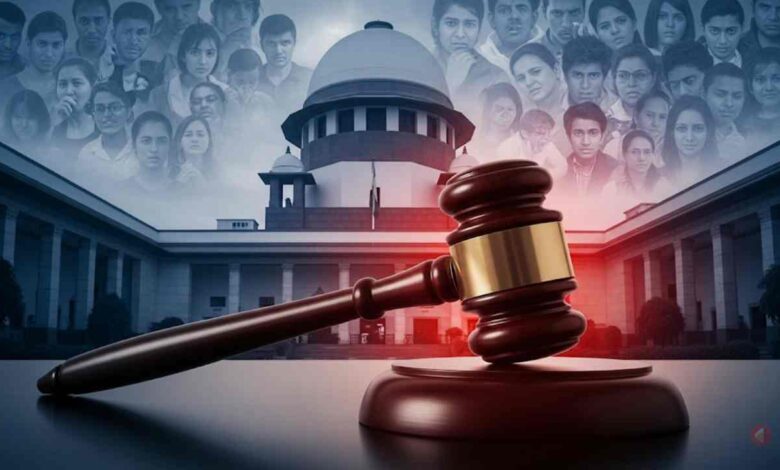
On 13 September 2022, the Supreme Court of India delivered its judgment in Civil Appeal No. 11698 of 2018, clarifying the issue of seniority and promotion within the West Bengal Judicial Service. The Court, speaking through Justice Sanjay Kishan Kaul and Justice M.M. Sundresh, set aside the Calcutta High Court’s orders and restored the rightful seniority of a promotee judicial officer whose claim had been unsettled due to administrative delays and the introduction of new service rules.
Background
The appellant, a judicial officer appointed in 1989, was found suitable for empanelment in the West Bengal Higher Judicial Service (WBHJS) by the Full Court of the High Court in December 2003. A communication was sent to the State Government recommending his promotion. He was subsequently posted as a Fast Track Court Judge.
In October 2004, the West Bengal Judicial (Conditions of Service) Rules, 2004 came into force, introducing a three-tier system of recruitment to the cadre of District Judges—direct recruits, promotees, and limited competitive examination candidates—along with a 40-point roster for determining seniority.
Although vacancies arose between 2004 and 2008, these were not filled promptly. Recruitment and promotions were eventually carried out in 2009, but the appellant was placed below officers who entered service later, thereby adversely affecting his seniority.
To address this, the High Court issued a draft gradation list in 2016, recognizing the appellant’s rightful claim against earlier vacancies. However, this draft was challenged before the High Court, which ultimately declined relief.
Issues Before the Court
- Whether the appellant’s seniority should be reckoned from the vacancies that arose between 2004–2008, in light of the 2003 empanelment decision.
- Whether the High Court was justified in rejecting the appellant’s claim by relying strictly on the 2004 Rules and subsequent recruitment.
Supreme Court’s Findings
- The Court held that the draft gradation list of 2016 was a legitimate administrative attempt to rectify an earlier mistake and recognize the appellant’s due promotion.
- It noted that the appellant was already found fit for promotion in 2003, well before the new rules came into effect. Therefore, his claim against the vacancies arising up to 2008 was valid.
- The Court emphasized that denying seniority until the 2009 recruitment would amount to withholding legitimate rights.
- At the same time, it clarified that the relief was confined to the appellant alone and would not affect other officers who were not party to the proceedings.
Judgment
The Supreme Court allowed the appeal and directed the High Court and the State Government to implement the draft gradation list of 2016 in respect of the appellant within 12 weeks. It further clarified that its decision would not disturb the seniority or promotion of other officers who had already been cleared by the Collegium process.
Counsel’s Role
In this matter, Madhumita Bhattacharjee, as part of the counsel team, contributed to placing the appellant’s case effectively before the Court. The arguments underscored:
- The administrative lapse in not granting timely promotion despite a 2003 empanelment.
- The inequity of placing the appellant below officers recruited later.
- The validity of the 2016 draft gradation list as a corrective measure acknowledging past errors.
These submissions were central to the Court’s recognition of the appellant’s rightful claim.
Significance
This judgment underscores the Supreme Court’s role in safeguarding fair service rights of judicial officers. It highlights that:
- Administrative errors in implementing promotions cannot defeat the legitimate rights of officers.
- Seniority must reflect not just technical rules but also the principle of fairness, particularly when delays are attributable to the system rather than the officer.
By reaffirming these principles, the Court has ensured that fairness and equity remain cornerstones of judicial service administration.