Can a senior government servant’s application for voluntary retirement be kept in limbo for over four years and then rejected? Does the State Government retain the power to refuse voluntary retirement long after the statutory notice period has expired? These were the central questions before a Division Bench of the Delhi High Court in a writ petition decided on July 5, 2023. In this matter, Advocate Madhumita Bhattacharjee, Managing Partner of Lexcuria, appeared as counsel for the State of West Bengal (Respondent No. 2) before the High Court.
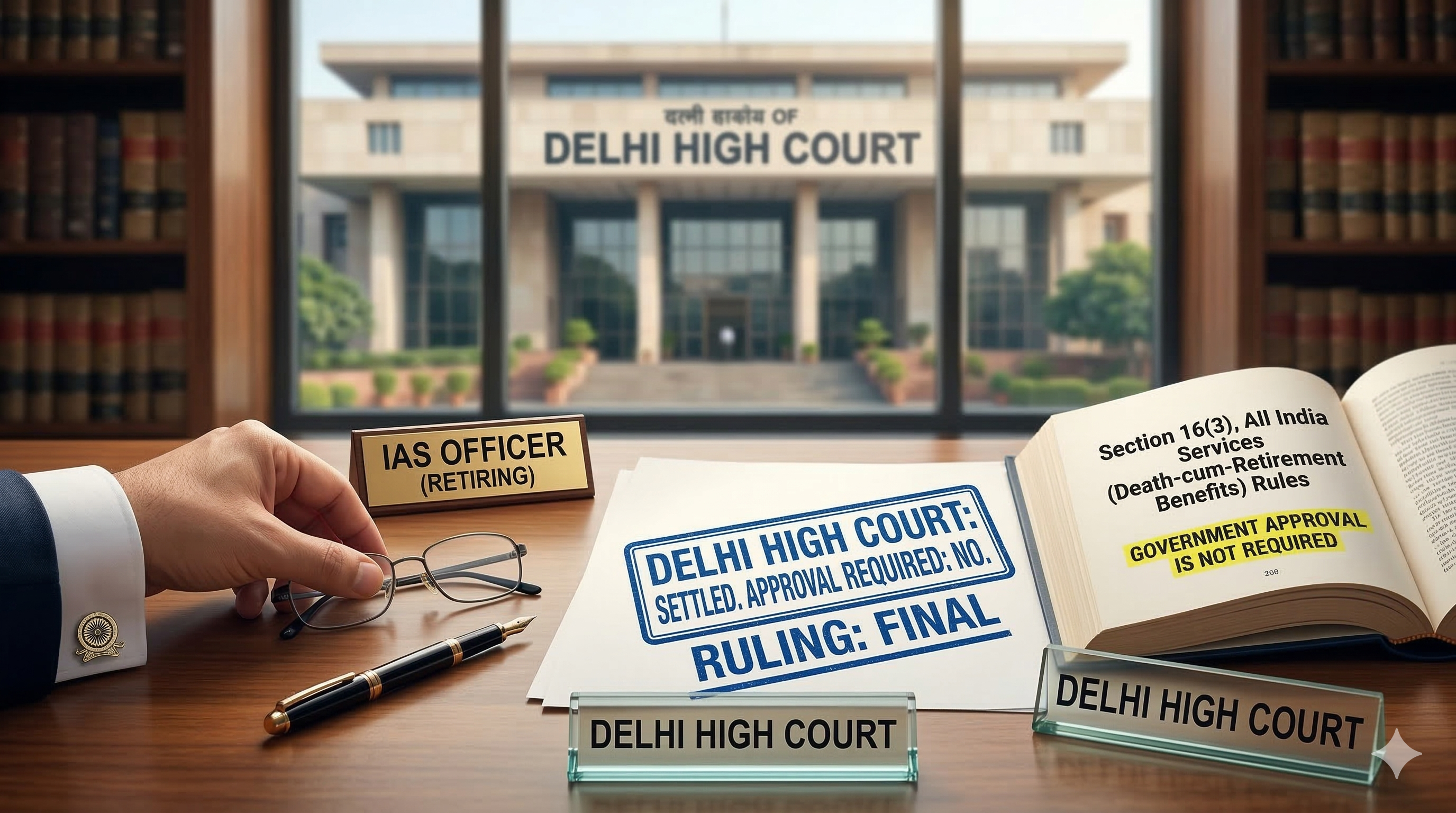
The judgment delivered by a Bench comprising Hon’ble Mr. Justice V. Kameswar Rao and Hon’ble Mr. Justice Anoop Kumar Mendiratta provides authoritative clarity on the nature of the right to voluntary retirement under the All India Services (Death-cum-Retirement Benefits) Rules, 1958 (the “Rules”), and reaffirms the principle that silence by the competent authority within the notice period amounts to deemed acceptance of the retirement application.
Background: An IAS Officer, an International Role, and a Stalled Retirement
The case arose from the situation of a 1986-batch IAS officer of the West Bengal cadre who, while on central deputation, received an offer of appointment as Regional Director at an international civil aviation body for a term of four years. When the cadre clearance for this international assignment was denied by the State Government in January 2014, the officer submitted an application for voluntary retirement effective March 31, 2014, under Rule 16(2) of the Rules.
Since the notice fell slightly short of the prescribed three-month period, a request for relaxation of the notice period was also made. No decision — either accepting or rejecting the request — was communicated by the State Government within the three-month notice window. The officer thereafter took up the international posting.
It was only in March 2018 — more than four years after the application — that the State Government communicated its inability to accept the voluntary retirement request. This belated refusal, reiterated through a subsequent communication by the Central Government, was challenged before the Central Administrative Tribunal, which allowed the original application and held that the voluntary retirement stood deemed accepted upon expiry of 90 days from the date of application.
Arguments Advanced on Behalf of the State of West Bengal
Advocate Madhumita Bhattacharjee, appearing for the State of West Bengal before the Delhi High Court, contested the Tribunal’s order by advancing the following arguments:
- The cadre clearance for the international posting had been expressly denied in January 2014. Having not received clearance, the officer was required to rejoin the parent cadre upon conclusion of tenure leave. His failure to do so, and his subsequent joining of the international organisation without permission, constituted a serious breach of service discipline.
- The grant of voluntary retirement is a matter of discretion vested in the employer, to be exercised with due regard to the exigencies of service. The State Government was entitled to refuse the application.
- The officer had sought to conflate two distinct issues before the Tribunal — his failure to rejoin the cadre and the rejection of his voluntary retirement application — which operate on entirely different legal parameters.
- Reliance was placed on the Supreme Court’s ruling in H.P. Horticultural Produce Marketing & Processing Corporation Ltd. v. Suman Behari Sharma [(1996) 4 SCC 584], Reserve Bank of India v. Cecil Dennis Solomon [(2004) 9 SCC 461], and other precedents, to urge that voluntary retirement under the applicable rules required the employer’s acceptance.
The High Court’s Reasoning: Rule 16(2) Does Not Require Employer Acceptance
The Division Bench dismissed the writ petition and upheld the Tribunal’s order. The Court’s reasoning proceeded on several key grounds.
The Text of Rule 16(2) Is Self-Operative. The Court carefully examined the language of Rule 16(2), which provides that a member of service “may, after giving at least three months’ previous notice in writing to the State Government, retire from service” upon fulfilling the specified conditions of age or qualifying service. Nothing in the Rule pre-supposes or requires acceptance by the employer. The discretion contemplated under the Rule is that of the government servant, not the State Government.
Rejection Must Be Communicated Within the Notice Period. Relying on the Supreme Court’s authoritative ruling in State of Haryana v. S.K. Singhal [(1999) 4 SCC 293], the Court reiterated that even where the rules empower the competent authority to withhold permission to retire in specific contingencies, the authority must pass a positive order to that effect and communicate it to the employee before the expiry of the notice period. Failure to do so results in the voluntary retirement taking effect automatically.
A Four-Year Delay Renders Rejection Legally Infirm. The purported rejection communicated in March 2018 — over four years after the notice was submitted in January 2014 — was wholly outside the legally permissible timeframe. By the time the refusal was communicated, the retirement had already taken effect by operation of law.
Rule 16(2)(C) Is Clarificatory, Not Retrospectively Restrictive. The 2017 amendment to the Rules, which explicitly introduced the concept of deemed acceptance upon expiry of the notice period without an order from the competent authority, was argued by the petitioner to be prospective and therefore inapplicable. The Court rejected this argument, holding that the amendment merely codified and made explicit what was always the legal position under Rule 16(2) as interpreted by the Supreme Court — it did not introduce a new right.
H.P. Horticultural Case Distinguished. The Court distinguished the H.P. Horticultural ruling relied upon by both the Union of India and the State of West Bengal, noting that the rule considered in that case specifically contemplated a scenario where employer permission was required before retirement could take effect. Rule 16(2), by contrast, contains no such requirement.
Advocate Madhumita Bhattacharjee’s Appearance in the Matter
Advocate Madhumita Bhattacharjee, Managing Partner at Lexcuria, appeared before the Division Bench of the Delhi High Court as counsel for the State of West Bengal. She advanced substantive arguments on the discretionary nature of the employer’s power to refuse voluntary retirement, the conduct of the officer concerned, and the applicable precedents governing the service law framework. The matter required careful navigation of complex intersections between All India Service Rules, Supreme Court precedents on voluntary retirement, and the specific factual matrix involving an IAS officer’s international assignment.
Key Legal Principles Reaffirmed by the Judgment
- Rule 16(2) of the All India Services (Death-cum-Retirement Benefits) Rules, 1958 confers a self-operative right on government servants to seek voluntary retirement upon fulfilling eligibility conditions. No acceptance by the employer is required.
- Where the competent authority has the power to withhold permission to retire, it must pass a positive order to that effect and communicate it before expiry of the notice period. Silence equals deemed acceptance.
- A rejection communicated years after the expiry of the notice period has no legal effect — the voluntary retirement would have already taken effect by operation of law.
- The 2017 amendment introducing sub-rule 16(2)(C) is declaratory in nature — it confirms the pre-existing legal position rather than creating a new rule prospectively.
Why This Judgment Matters for Government Servants and Employers
This judgment is a significant reference point for All India Service officers and State Governments alike. For government servants, it firmly establishes that the right to voluntary retirement under Rule 16(2) is not contingent on the goodwill or approval of the employer. Once the eligibility conditions are met and a valid notice is served, the retirement takes effect automatically at the end of the notice period unless a timely, reasoned, and duly communicated order of refusal is passed.
For State Governments and the Central Government as cadre-controlling authorities, the ruling is a reminder that inaction is not a neutral act in the context of voluntary retirement applications. Allowing the notice period to lapse without issuing a positive order of refusal — where such power exists — results in the irreversible taking effect of retirement. Authorities cannot subsequently revisit or reverse this outcome through belated communications.
The judgment also reinforces the broader principle running through Indian service law jurisprudence: the right to retire is a statutory right, not a contractual privilege, and its exercise is governed by the plain language of the applicable rules and not by administrative convenience.
Conclusion
The Delhi High Court’s judgment of July 5, 2023 is a clear and unambiguous affirmation of a principle long embedded in Indian service law: the right to voluntary retirement under Rule 16(2) of the All India Services (Death-cum-Retirement Benefits) Rules, 1958 is a statutory right vested in the government servant, not a privilege subject to the unfettered discretion of the employer. Once a valid notice is submitted and the notice period lapses without a timely, communicated order of refusal, the retirement takes effect automatically — irrespective of whether the authority subsequently chooses to issue a belated rejection.
The ruling also draws an important line between two questions that are frequently conflated in practice: the question of whether an officer has complied with service obligations (such as reporting to the parent cadre) is entirely separate from the question of whether a voluntary retirement application has taken legal effect. Each falls to be decided on its own parameters and cannot be used to undermine the other.
The case further illustrates that a 2017 statutory amendment which codifies an already-settled legal position does not create a new prospective right — it merely removes ambiguity and places beyond doubt what courts and tribunals had consistently recognised over decades. Arguments seeking to use such amendments as a device to resist pre-amendment claims are unlikely to find favour.
For practitioners navigating service law matters, this judgment serves as a reliable precedent on the interplay between statutory rules, employer discretion, and the doctrine of deemed acceptance. Advocate Madhumita Bhattacharjee’s appearance in this matter before the Delhi High Court reflects Lexcuria’s active engagement with complex service law litigation at the highest judicial forums, and the firm’s commitment to rigorous legal representation in matters of constitutional and administrative significance.