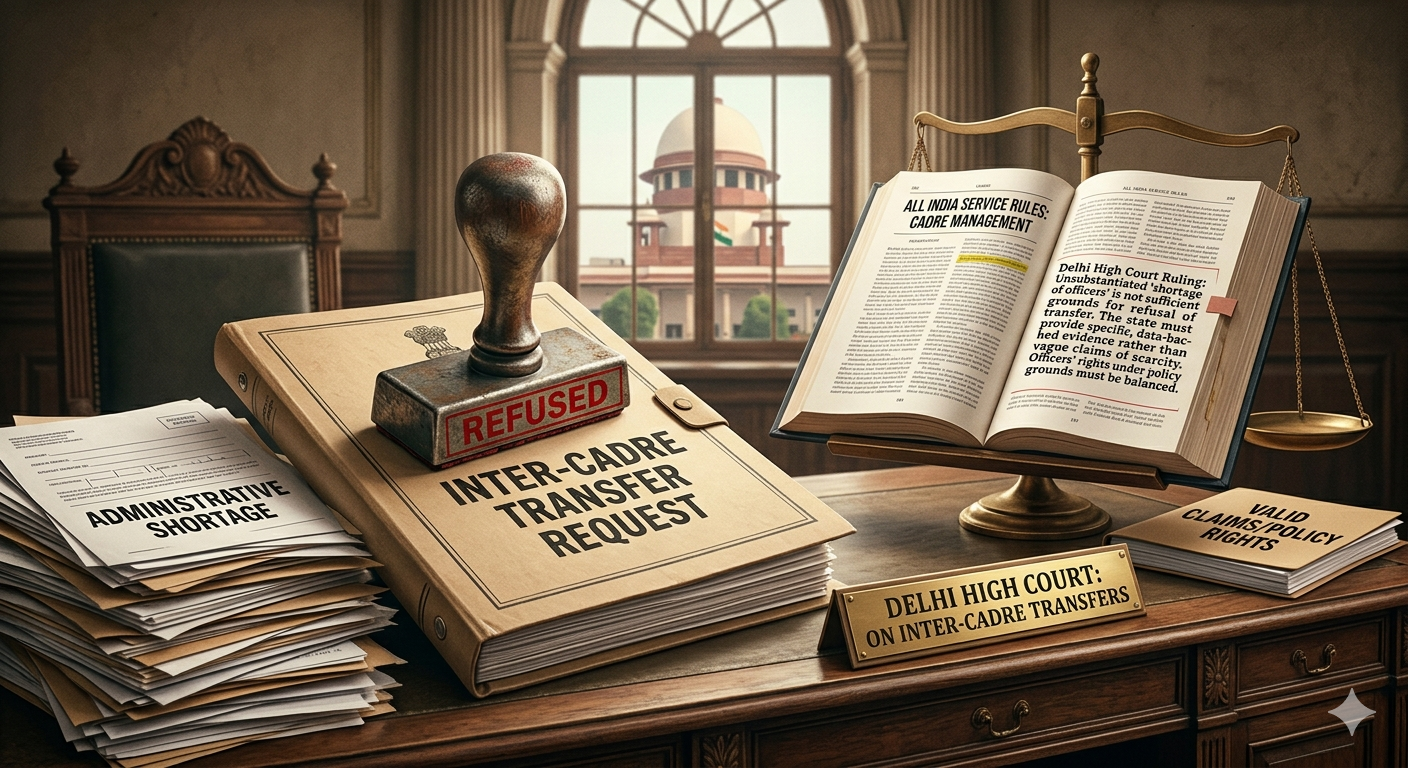
There is a difference between stating a ground for refusal and substantiating it. In the context of inter-cadre transfer requests by All India Service officers, this distinction has become increasingly significant. Courts have long held that cadre shortage, standing alone as a bald assertion, is not a sufficient basis for denying an officer’s request for transfer to join a spouse in another cadre. A refusal must be backed by relevant material — actual data, documented analysis, and reasons that go beyond a formulaic invocation of shortage.
A Division Bench of the Delhi High Court, comprising Hon’ble Mr. Justice Rajiv Shakdher and Hon’ble Mr. Justice Talwant Singh, delivered a judgment on August 27, 2021 that makes this point with unusual directness — and with an observation about the State Government’s pattern of conduct across multiple matters that carries weight beyond the individual case. Advocate Madhumita Bhattacharjee, Managing Partner of Lexcuria, appeared as counsel for the State Government before the Division Bench.
Background: An IAS Officer, an IFS Spouse, and a Five-Year Refusal
The case concerned an Indian Administrative Service officer serving in the West Bengal cadre who had applied for an inter-cadre transfer as far back as April 2016. The basis for the transfer request was marriage: her spouse was an Indian Forest Service officer of the 2012 batch, posted in the Uttarakhand cadre. The officer sought to transfer her IAS cadre from West Bengal to Uttarakhand so that the couple could be posted in the same State.
The State Government rejected the request in November 2016, citing shortage of officers as the ground for refusal. No further substantiation was offered. The officer challenged this rejection before the Central Administrative Tribunal. In July 2021 — over four and a half years after the initial application — the Tribunal allowed the original application, set aside the November 2016 rejection order, and directed the State Government to pass fresh orders within six weeks. A deemed-relieving clause was included: if the officer was not relieved within six weeks, she would stand deemed relieved upon expiry of that period.
The State Government filed a writ petition before the Delhi High Court challenging the Tribunal’s order, simultaneously seeking a stay on its operation. Advocate Madhumita Bhattacharjee appeared for the State before the Division Bench.
Advocate Madhumita Bhattacharjee’s Appearance Before the Division Bench
Advocate Madhumita Bhattacharjee appeared as sole counsel for the State of West Bengal before the Division Bench in these proceedings conducted via video conferencing. She advanced the State’s position in support of the writ petition and the stay application, placing the State’s case on cadre shortage before the Bench. The proceedings were expeditious — the Court, having examined the record and heard the parties, dismissed the petition on the day of hearing itself.
The Court’s Judgment: A Pattern-Based Observation and a Clear Standard
The Division Bench dismissed the writ petition, declining to interfere with the Tribunal’s order. The Court’s reasoning was structured around three distinct and progressively significant observations.
The Entitlement Is Not in Dispute. The Court noted, as a preliminary point, that there was no dispute that the officer was entitled to seek inter-cadre transfer under Rule 5(2) of the Indian Administrative Service (Cadre) Rules, 1954. The legal entitlement was not in question. The only question was whether the State’s refusal was valid.
Shortage Without Material Is Not a Reason. The Court observed that the State had “trotted out” shortage of officers as the reason for rejection without placing the relevant material on record. This is a pointed choice of language. To ‘trot out’ a ground is to invoke it reflexively, without genuine engagement with its substance. The Court’s use of this phrase signals that a bald assertion of shortage, unaccompanied by supporting material — data on cadre strength, authorised strength versus posted strength, the impact of the specific transfer on operational capacity — will not constitute a legally sufficient reason for refusal.
A Pattern Across Matters: The Court Takes Note. The most significant observation in the judgment goes beyond the individual case. The Court expressly noted that this approach — refusing inter-cadre transfer requests on the ground of shortage, without substantiation — had been taken by the State Government “in matter after matter” where officers had sought transfer to other States on account of marriage. This is a judicial observation of institutional pattern, not merely individual conduct. It signals that the Court is aware of and has formed a view on the State’s systemic approach to such requests — and that this approach will not pass judicial scrutiny.
The Standard Going Forward. The Court stated with clarity: unless the reasons set out in an order of refusal for inter-cadre transfer are backed by relevant material, the refusal cannot pass muster before the Court. This is not a new principle — it is the standard of reasoned decision-making that administrative law has long required. But its articulation in this context, in the face of a recurring pattern of bare assertions, gives it renewed operational significance.
The IFS-IAS Cross-Service Dimension
This case has a dimension that distinguishes it from several others in this body of litigation: the officer seeking transfer is an IAS officer, while her spouse is an IFS — Indian Forest Service — officer. The inter-cadre transfer framework under Rule 5(2) of the IAS Cadre Rules operates between State cadres within the IAS. The case therefore involves not merely a spousal posting in a different State cadre of the same service, but a cross-service family situation where the two officers belong to two distinct All India Services.
The Court’s finding that the officer was undisputedly entitled to seek the transfer is therefore significant in this cross-service context as well. The right to seek inter-cadre transfer on the ground of marriage is not restricted to situations where both spouses belong to the same All India Service. The entitlement extends to situations where the officer’s spouse belongs to a different All India Service posted in a different State cadre.
Key Legal Principles Affirmed
- A refusal of an inter-cadre transfer request on the ground of shortage of officers must be backed by relevant material placed on record. A bald assertion of shortage, without supporting data or documentation, will not withstand judicial scrutiny.
- The right to seek inter-cadre transfer under Rule 5(2) of the IAS Cadre Rules on the ground of marriage extends to situations where the officer’s spouse belongs to a different All India Service, such as the IFS, posted in a different State cadre.
- Courts will take note of and comment on institutional patterns in the conduct of State Governments across multiple matters, not merely the conduct in the individual case before them.
- A Tribunal direction to pass a fresh order, accompanied by a deemed-relieving clause, is a proportionate and legally sound remedy where the original refusal was unsubstantiated. The High Court will not interfere with such a direction.
Conclusion
The Delhi High Court’s judgment of August 27, 2021 is notable not just for its outcome — which is consistent with the established line of precedent in inter-cadre transfer cases — but for the language in which it is expressed. The Court’s observation that the State had ‘trotted out’ the shortage ground, and its express notice of this approach being taken ‘matter after matter’, is a judicial signal of the clearest kind: the era of bare assertions as a substitute for substantiated reasons is over.
For State Governments defending inter-cadre transfer refusals, the practical implication is significant. A refusal order that simply states “there is a shortage of officers” is legally vulnerable from the moment it is passed. To be defensible before a Tribunal or a High Court, the order must be accompanied by: the sanctioned cadre strength, the actual posted strength, the number of officers currently on deputation or leave, the impact of the proposed transfer on operational capacity, and any other material that gives substance to the claim of shortage. Without this, the refusal is a conclusion without premises — and courts will treat it accordingly.
For All India Service officers — whether IAS, IPS, or IFS — whose transfer requests have been refused with a bare assertion of shortage, this judgment affirms that such refusals are legally challengeable and that courts have both the willingness and the tools to address them. The deemed-relieving clause in the Tribunal’s order, upheld by the High Court, ensures that the relief is not just symbolic but operationally effective.
Advocate Madhumita Bhattacharjee’s appearance for the State of West Bengal in this matter — as sole counsel before the Division Bench — is part of Lexcuria’s sustained engagement with All India Service litigation at the Delhi High Court, where the firm has represented State Governments across the full range of inter-cadre transfer, voluntary retirement, contempt, and constitutional service law disputes.