Inter-cadre transfer requests by All India Service officers are most often associated with grounds of spouse posting or administrative exigency. However, a distinct and equally important category involves requests grounded in genuine medical necessity — where the health of the officer or a dependent family member is materially and verifiably affected by the environment of the posting State. In such cases, the question that frequently arises is: once an independent Medical Board certifies the health concern and recommends a change of environment, can the State Government continue to resist relieving the officer on grounds of cadre shortage?
The Delhi High Court addressed this question in a judgment delivered on August 16, 2023, in proceedings where Advocate Madhumita Bhattacharjee, Managing Partner of Lexcuria, appeared as counsel for the State Government before the Division Bench presided over by Hon’ble Mr. Justice V. Kameswar Rao.
Background: A Health Crisis, a Medical Board, and a Stalled NOC
The case concerned an IPS officer serving in the West Bengal cadre who, along with a dependent child, was experiencing significant and documented health difficulties attributed to the climatic and environmental conditions of the posting State. Medical opinion indicated that the humid environment was adversely affecting their respiratory, ENT, and skin conditions, and that a shift to a drier environment was recommended for their wellbeing.
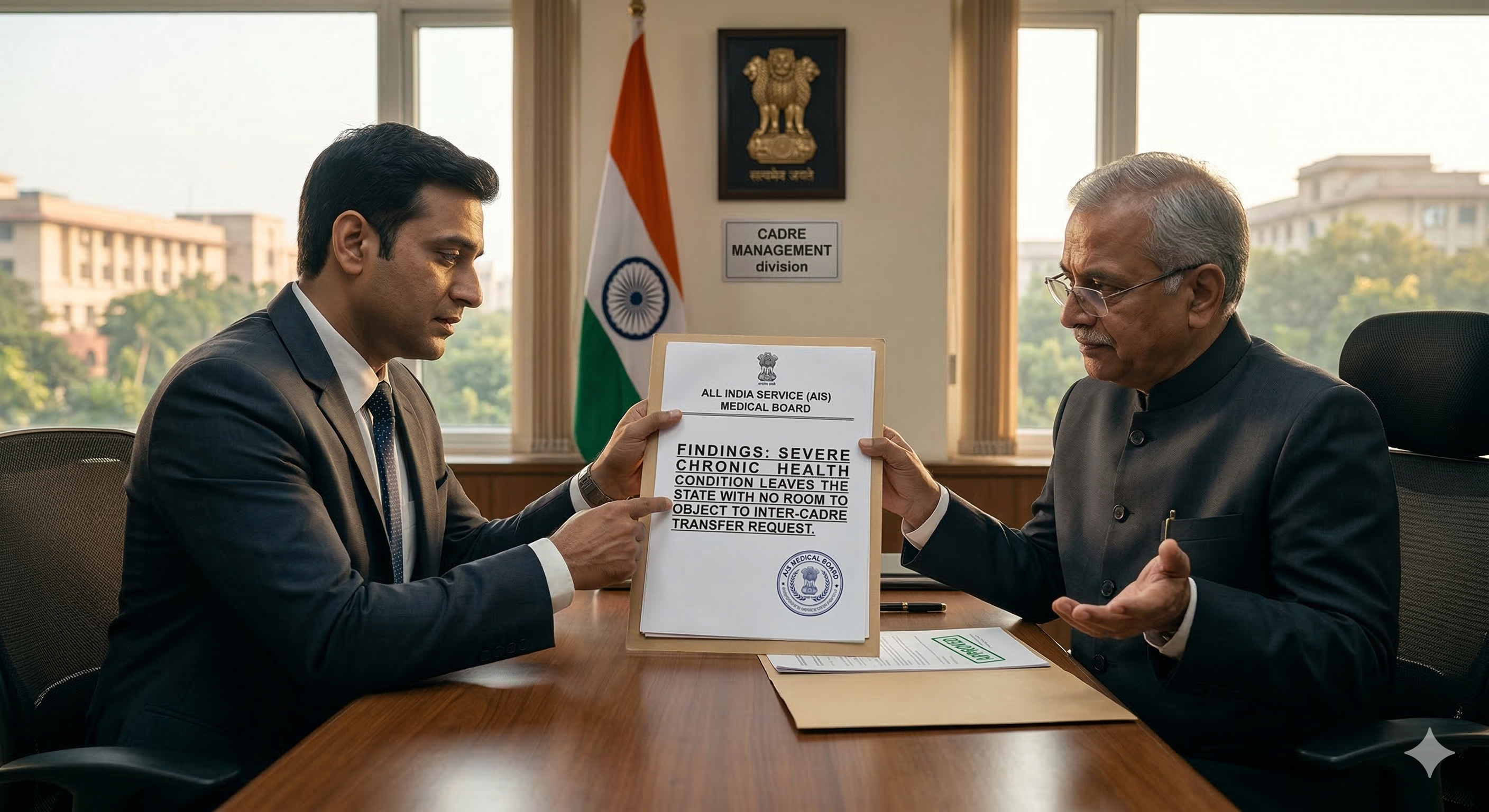
Pursuant to a direction of the Central Administrative Tribunal, the officer and the dependent child were referred to a Medical Board constituted at Safdarjung Hospital, New Delhi — a Central agency — as required under the Department of Personnel and Training (DoPT) policy guidelines on health-based inter-cadre transfer requests. The Medical Board, comprising specialists from ENT, Skin, and Respiratory Medicine, examined the officer and the child and rendered its findings.
The Board’s opinion was unambiguous: humid environmental conditions were identified as a contributing factor to their medical conditions, a change to a drier environment was recommended, and it was noted that the officer appeared to have benefitted from removal from the humid environment. On the basis of these findings, the Government of India arranged for the officer to be sent on a three-year deputation to another State, with the officer’s spouse also being accommodated on deputation to an adjoining State.
Despite this, the State Government challenged the Tribunal’s original order before the Delhi High Court, contending that the direction to facilitate the deputation arrangement was not warranted.
The DoPT Policy Framework on Health-Based Transfer Requests
Central to the Court’s analysis was the DoPT policy governing inter-cadre transfer requests on grounds of health or threat. The relevant policy provisions, which the Court reproduced in its order, lay down a structured framework:
- Where a request for inter-cadre transfer is made on grounds of health, the Central Government is required to have the genuineness of the request assessed by an independent Central agency or a group of at least two independent experts.
- If the request is found to be genuine, the Central Government may initially send the officer on a three-year deputation to a State of its choice.
- The situation is to be re-assessed after the three-year deputation period, and if the circumstances so warrant, the Central Government may permanently transfer the officer to that State.
This framework is significant because it places the decision-making authority firmly with the Central Government once a genuine health ground is established through an independent medical assessment. The State Government’s role in resisting the process is, by design, limited.
Advocate Madhumita Bhattacharjee’s Submission and the Court’s Response
Advocate Madhumita Bhattacharjee, appearing for the State of West Bengal, accepted the position under the Rules but made a specific submission to the Court: given the significant hardship faced by the State on account of the shortage of officers, the Court should issue a direction that the mandatory re-assessment of the situation — provided for under the DoPT Rules after the expiry of the three-year deputation period — be carried out strictly upon expiry of three years, without any extension or delay.
The Court, while noting the submission, declined to issue a specific direction in this regard. The Bench observed that no such direction was necessary because the Rule position was already clear — re-assessment after three years is mandated by the policy itself, and it was not for the Court to add to or qualify what the Rules already provide. The existing framework was sufficient to protect the State’s interests at the point of re-assessment.
The Court thereafter directed the State Government to issue the NOC to the Ministry of Home Affairs within two weeks, to enable the Government of India to proceed with the deputation arrangement in accordance with the Rules. The petition was accordingly disposed of.
What Makes This Case Significant
The Role of an Independent Medical Board Is Decisive. The judgment illustrates that once a Medical Board constituted by a Central agency renders a clear finding that the environment of the posting State is contributing to a documented health condition — and that relocation would be beneficial — the evidentiary threshold for a health-based transfer request is met. The State’s administrative preferences cannot override a verified medical necessity.
The Central Government’s Authority Is Paramount. Under the DoPT framework, once the Central Government determines that a health-based request is genuine and initiates the deputation process, the State cadre authority does not possess an independent veto. The NOC is an administrative formality that must follow the Central Government’s decision, not a separate discretionary hurdle for the State to exercise.
Cadre Shortage Does Not Override Health Necessity. As with spouse-posting cases, the Court declined to allow cadre shortage to function as a blanket justification for resisting a transfer that had been found justified on independent medical grounds. The State’s concern about officer availability is a legitimate institutional interest, but it operates within the framework of the Rules — not outside it.
The Three-Year Re-Assessment Protects State Interests. The policy framework is not entirely one-sided. The built-in re-assessment mechanism after three years ensures that deputation granted on health grounds does not automatically become a permanent transfer. The State retains the opportunity to demonstrate, at the re-assessment stage, that the officer’s return to the cadre is warranted. This balance is an important feature of the policy that State Governments should actively utilise.
Advocate Madhumita Bhattacharjee’s Appearance in the Proceedings
Advocate Madhumita Bhattacharjee, Managing Partner at Lexcuria, appeared before the Delhi High Court as counsel for the State of West Bengal. She engaged with the applicable DoPT policy framework, accepted the Rule position on behalf of the State, and advanced a focused submission on the State’s legitimate interest in ensuring that the re-assessment after three years is carried out in a timely manner, without extension or dilution. Her appearance reflects Lexcuria’s active practice in service law matters before national tribunals and High Courts, representing State Governments and public authorities on questions of All India Service regulations and administrative law.
Key Legal Principles Reaffirmed
- Health-based inter-cadre transfer requests must be assessed by an independent Central Medical Board under DoPT guidelines — the State cadre authority cannot substitute its own assessment.
- Once the Medical Board confirms the genuineness of the health concern, the Central Government’s decision to send the officer on deputation is binding, and the State must issue the NOC.
- Cadre shortage is not a ground to override a medically verified transfer request supported by Central Government action.
- The three-year deputation with mandatory re-assessment is a balanced policy mechanism — it is not a permanent transfer and the State’s interests are preserved at the re-assessment stage.
Conclusion
The Delhi High Court’s order of August 16, 2023 is a concise but important affirmation of the DoPT’s health-based inter-cadre transfer framework and its precedence over State-level administrative objections. It confirms that where the prescribed process has been followed — a Medical Board has been constituted, an independent assessment has been made, and the Central Government has acted on that assessment — the State’s role is to facilitate, not obstruct, the consequent deputation.
For All India Service officers who have genuine health concerns aggravated by their posting environment, this case underscores the importance of following the prescribed procedural pathway: seeking a Medical Board assessment through the Central Government, documenting the health condition rigorously, and pursuing the matter before the Tribunal if the State fails to act. A well-documented health record supported by specialist opinion is the cornerstone of a successful health-based transfer request.
For State Governments, the judgment is a reminder that the Rules governing health-based transfers are not merely directory — they are binding on all parties, including the cadre-controlling State authority. The appropriate arena to protect the State’s interest is the re-assessment process at the end of three years, not resistance to an NOC that the Rules and the Central Government’s decision already require to be issued.
This case, in which Advocate Madhumita Bhattacharjee appeared as counsel for the State, adds to Lexcuria’s body of work in All India Service litigation, reflecting the firm’s engagement with the full spectrum of service law issues — from voluntary retirement and inter-cadre transfers on spouse-posting grounds to medically necessitated deputation cases — before the Delhi High Court and the Central Administrative Tribunal.