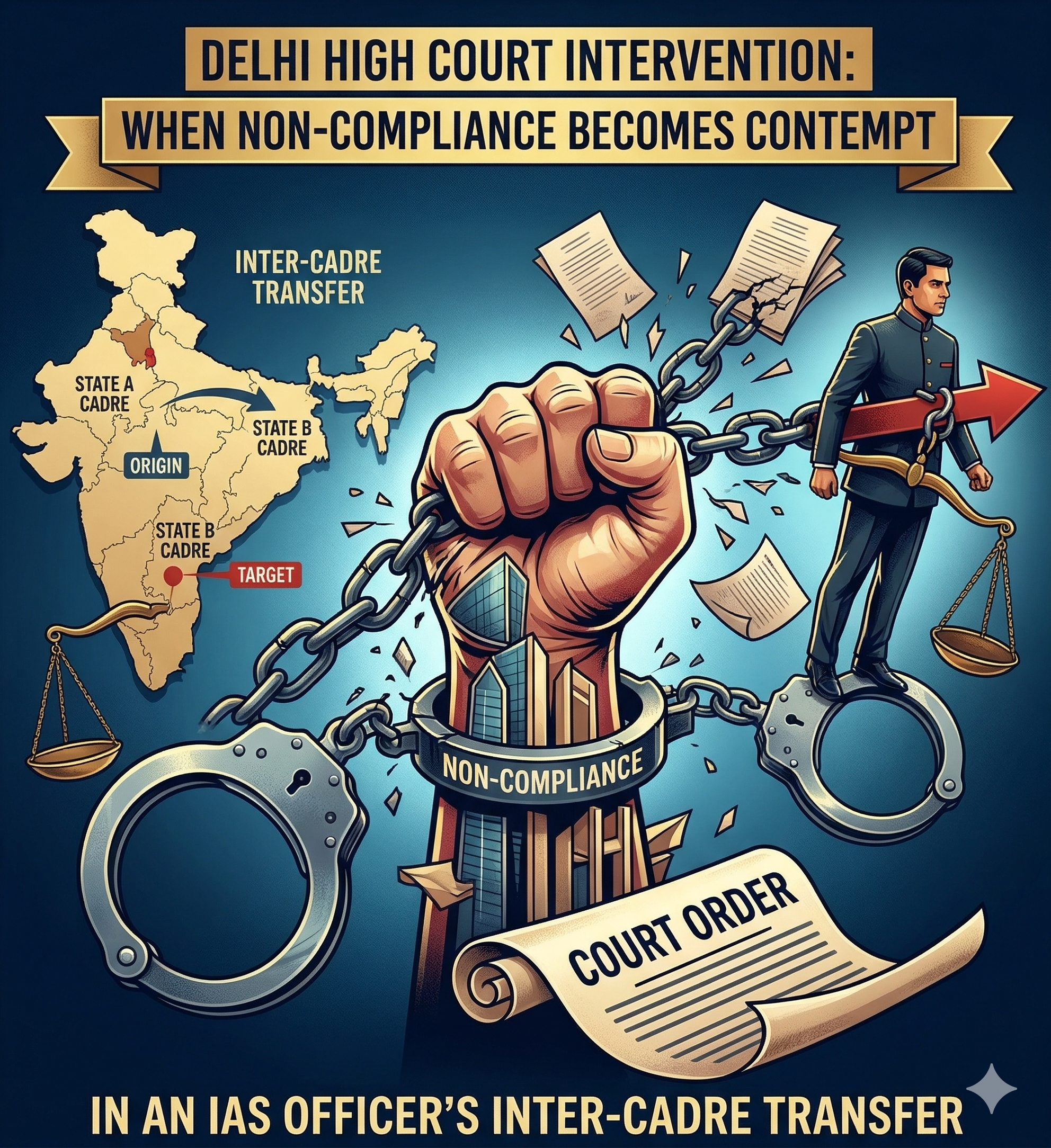
In Indian service law, a court’s direction to consider and decide an officer’s representation is not a mere formality. It is a binding judicial mandate. When a State Government receives such a direction and chooses to respond with inaction, or with a decision that patently disregards the legal framework the court had directed it to apply, the consequence is not simply an adverse order on merits — it may amount to contempt of court.
A judgment delivered by the Delhi High Court on October 12, 2021 by Hon’ble Mr. Justice Najmi Waziri in a contempt petition arising out of an IAS officer’s inter-cadre transfer proceedings illustrates this principle with clarity and force. Advocate Madhumita Bhattacharjee, Managing Partner of Lexcuria, appeared as counsel for the respondent in this matter.
Background: A Long Road to a Relieving Order
The case concerned an IAS officer serving in the West Bengal cadre who had, over a period of years, been seeking an inter-cadre transfer to join the AGMUT cadre, where her husband — also a government servant — was posted in Delhi. The request was rooted in the urgent need to preserve her family unit: her children, who were in school, had been living without their father for years, and the officer had also suffered personal hardship arising from the prolonged enforced separation.
Significantly, the Government of India had issued a No Objection Certificate for the cadre transfer as far back as June 2015. The DoPT had written to the State Government requesting it to release the officer for inter-cadre transfer in terms of the NOC. The receiving cadre had given its concurrence. By every measure, the institutional pathway for the transfer was clear and open.
Despite this, the State Government consistently declined to issue a relieving order. Proceedings were initiated before the Central Administrative Tribunal, and eventually a Division Bench of the Delhi High Court, in January 2021, directed the State Government to decide the officer’s pending representation within eight weeks, in accordance with three specific orders of the CAT and the High Court. The direction was precise: the State was to apply the law as laid down in those orders, not exercise a fresh round of unconstrained discretion.
The Contempt Petition: What Was Alleged
When the State Government eventually passed an order in February and July 2021 — declining the relief once again, citing acute cadre shortage and pandemic-related administrative pressures — the officer filed a contempt petition before the High Court. The petition alleged willful and deliberate disobedience of the Division Bench’s direction of January 2021.
The petitioner’s counsel argued that the Division Bench’s order left no scope for the State Government to exercise independent discretion on the merits of the transfer request. The direction was to decide the representation in accordance with specified orders that had already settled the law — which meant the only legally permissible outcome was the issuance of a relieving order.
Arguments Advanced by Advocate Madhumita Bhattacharjee on Behalf of the Respondent
Advocate Madhumita Bhattacharjee, appearing for the respondent, advanced the following arguments in defence against the contempt petition:
- Compliance with the direction: The Division Bench’s order of January 2021 had directed the State to decide the officer’s representation within eight weeks. The State Government had, in fact, passed an order on the representation — and communicated it. This, it was submitted, constituted compliance with the direction, since the court had directed a decision to be taken, not a particular outcome.
- Acute cadre shortage and pandemic pressures: The State placed on record that there was a serious shortage of IAS officers in the West Bengal cadre, and that the administrative machinery was significantly stretched due to the COVID-19 pandemic. These were submitted as legitimate grounds for the refusal.
- Transfer discretion rests with the employer: Reliance was placed on the Supreme Court’s observation that it is for the employer to decide questions of transfer considering service requirements, and not for the employee to insist on a particular transfer.
- Doctrine of approbate and reprobate: It was argued that since the officer had sought the transfer of her matrimonial case proceedings to the West Bengal jurisdiction for her own convenience, she was estopped from now asserting that she did not intend to remain in West Bengal.
- Unconditional apology: The respondent tendered an unconditional apology for any unintentional breach of the court’s directions.
The Court’s Finding: Contempt Established, Consequential Relief Granted
Hon’ble Mr. Justice Najmi Waziri rejected each of the respondent’s defences and found that contempt of court had been established. The Court’s reasoning was incisive.
The Direction Was Not Merely to ‘Consider’. The Division Bench’s January 2021 order had directed the State to decide the representation specifically “in accordance with” three identified orders of the CAT and the High Court. Each of those orders had settled that cadre shortage is not a valid ground to reject an inter-cadre transfer request on the ground of marriage or family exigency. Passing a fresh order of rejection on the same grounds, without reference to the binding framework, was not compliance — it was evasion.
Cadre Shortage: A Ground Long Foreclosed. The Court noted that the argument of cadre shortage had been specifically raised and conclusively rejected by the Delhi High Court in multiple Division Bench judgments involving the State of West Bengal in comparable situations. The SLP preferred by the State against one such judgment had been dismissed by the Supreme Court. This ground was no longer available to the State Government in any proceedings of this nature.
The Matrimonial Case Transfer Argument Was Irrelevant. The Court dismissed the approbate and reprobate argument with a pointed observation: the transfer of a matrimonial case to a particular court for the officer’s convenience had nothing to do with the decision-making process on the inter-cadre transfer request, and invoking it was, in the Court’s word, “inelegant”.
Contempt Jurisdiction Extends to Consequential Relief. Having found contempt established, the Court went further and granted the consequential relief that had been denied: the officer was directed to stand relieved from the IAS cadre of West Bengal within one week, and the DoPT was directed to treat the Court’s order itself as the relieving order enabling the officer to join the AGMUT cadre. All State Government orders refusing a relieving order were set aside.
The Apology Was Accepted. Since the respondent had tendered an unconditional apology at the outset for any unintentional breach, the Court accepted the apology and did not proceed to impose punishment beyond the consequential directions already issued.
Advocate Madhumita Bhattacharjee’s Appearance in the Proceedings
Advocate Madhumita Bhattacharjee, Managing Partner at Lexcuria, appeared as counsel for the respondent before the Delhi High Court in this contempt proceeding. She advanced a multi-pronged defence — on compliance, cadre exigency, the scope of employer discretion in transfer matters, and the approbate-reprobate doctrine — in a proceeding where the stakes were high: a finding of contempt carries the risk of penal consequences including imprisonment. The matter required engagement with the law on civil contempt, the scope of consequential relief in contempt jurisdiction, and the binding precedent on inter-cadre transfers accumulated across a series of Division Bench judgments.
Key Legal Principles Affirmed by the Judgment
- A court’s direction to decide a representation “in accordance with” identified orders is not a direction to exercise fresh discretion — it is a direction to apply the law as already settled in those orders. A decision that disregards that framework is non-compliance, not compliance.
- Passive or dormant non-compliance with a court’s direction — including the issuance of an order that evades the substance of the direction — constitutes civil contempt. Lethargy, institutional delays, and administrative pressures are not valid defences.
- In contempt proceedings, the High Court has the power to grant consequential relief — including issuing a relieving order directly — to ensure faithful implementation of its directions.
- Cadre shortage is a foreclosed ground in inter-cadre transfer cases of this nature, having been decisively rejected at both the Supreme Court and the Delhi High Court level in multiple prior proceedings.
Conclusion
The October 2021 judgment of the Delhi High Court is a powerful affirmation of the principle that judicial directions carry real binding force, and that compliance must be substantive — not technical or illusory. An order that directs a State Government to decide a representation in accordance with settled law cannot be satisfied by issuing a fresh refusal that ignores that law. Courts will not hesitate to treat such conduct as contempt, and will exercise their jurisdiction to grant the very relief that has been withheld.
For All India Service officers who have been waiting for years for inter-cadre transfers that have already been approved at the Central Government level, this judgment is a significant precedent. It demonstrates that where the legal entitlement is clear and the State’s resistance is without valid legal basis, the contempt jurisdiction of the High Court is a powerful and effective tool for enforcement — one that can result not just in the punishment of non-compliance, but in the direct grant of the relief that had been wrongfully withheld.
The case also carries a broader message about the interface between institutional authority and individual constitutional rights. The right to family life — to live with one’s spouse and children, to be present for one’s children’s formative years, to maintain a marriage across the distance of two State postings — is not a peripheral concern that can be indefinitely deferred by administrative inertia. Courts have shown, repeatedly and consistently, that they will intervene to protect it.
Advocate Madhumita Bhattacharjee’s appearance as counsel for the respondent in this high-stakes contempt proceeding reflects Lexcuria’s engagement with the full complexity of service law litigation — including the difficult terrain of contempt proceedings where institutional interests and individual rights come into direct conflict before the High Court.