In public procurement law, few actions carry consequences as serious as a banning order. When a government department or public undertaking decides to ban business dealings with a firm, the firm is effectively shut out from an entire segment of the market — often the government sector itself. Given this severity, the procedural safeguards that precede such an order are not mere formalities. They are mandatory requirements rooted in the principles of natural justice, and their absence renders the banning order legally vulnerable from the outset.
A judgment delivered by the Delhi High Court on March 15, 2021 by Hon’ble Mr. Justice Sanjeev Sachdeva illustrates this principle with precision. The Court, at the interlocutory stage, stayed the operation of a Railway Board banning order after finding, prima facie, that the order had been passed without a show cause notice being issued to the affected firm. Lexcuria appeared for the petitioner in this matter, with Mrs. Maninder Acharya, Senior Advocate, leading the arguments and Advocate Madhumita Bhattacharjee appearing as part of the counsel team.
Background: A Two-Year Banning Order and a Missing Show Cause Notice
The petitioner was a firm that had applied for registration as a supplier with the Ministry of Railways and had been dealing with the Railway Board in that capacity. In December 2020, the Railway Board passed an order banning business dealings with the petitioner for a period of two years, with effect from May 2020. The firm challenged this banning order before the Delhi High Court.
The central argument advanced before the Court was that no show cause notice had been issued to the petitioner before the banning order was passed. This, it was contended, was a fundamental violation of the mandatory procedural requirements governing such orders — both under the general principles of natural justice and, specifically, under the Railway Board’s own Vigilance Manual.
The Vigilance Manual Requirement: Show Cause Notice Is Mandatory
The Railway Board itself filed a set of documents before the Court at the hearing stage. Among these was Chapter XI of the Indian Railways Vigilance Manual, which the Court examined closely. Paragraph 1116 of the Manual, titled ‘Show Cause Notice’, mandates in express terms that before any orders of removal from the list of approved suppliers, or suspension or banning of business dealings, are passed, a show cause notice must be served on the firm and their representative, if any, and the reply thereto must be considered. The purpose of this requirement, as the Manual itself records, is to give the firm an opportunity to explain its position before any action is taken.
This is not an internal policy guideline — it is a mandatory precondition to the exercise of the banning power. Its significance in administrative law terms is clear: a power that can only be exercised after following a prescribed procedure cannot be validly exercised without that procedure, regardless of the substantive merits of the case against the firm.
The Railway Board’s Argument: A Memorandum Addressed to the Petitioner
The Railway Board’s counsel contended that a show cause notice had in fact been issued — a Memorandum dated August 10, 2020 was placed before the Court in support of this position. On examination, however, the Court found that the Memorandum proposed to ban business dealings with a different entity entirely, and that entity was given the opportunity to show cause against the proposed action. The petitioner firm was also addressed in the document, but the document did not indicate that any show cause notice had been issued to the petitioner specifically, or that any action was being proposed against the petitioner.
In other words, merely being a co-addressee of a document that issued a show cause notice to a different party is not equivalent to receiving a show cause notice oneself. The procedural protection exists for the specific entity against whom action is proposed — and that protection had not been afforded to the petitioner.
The Court’s Prima Facie Finding and Interim Stay
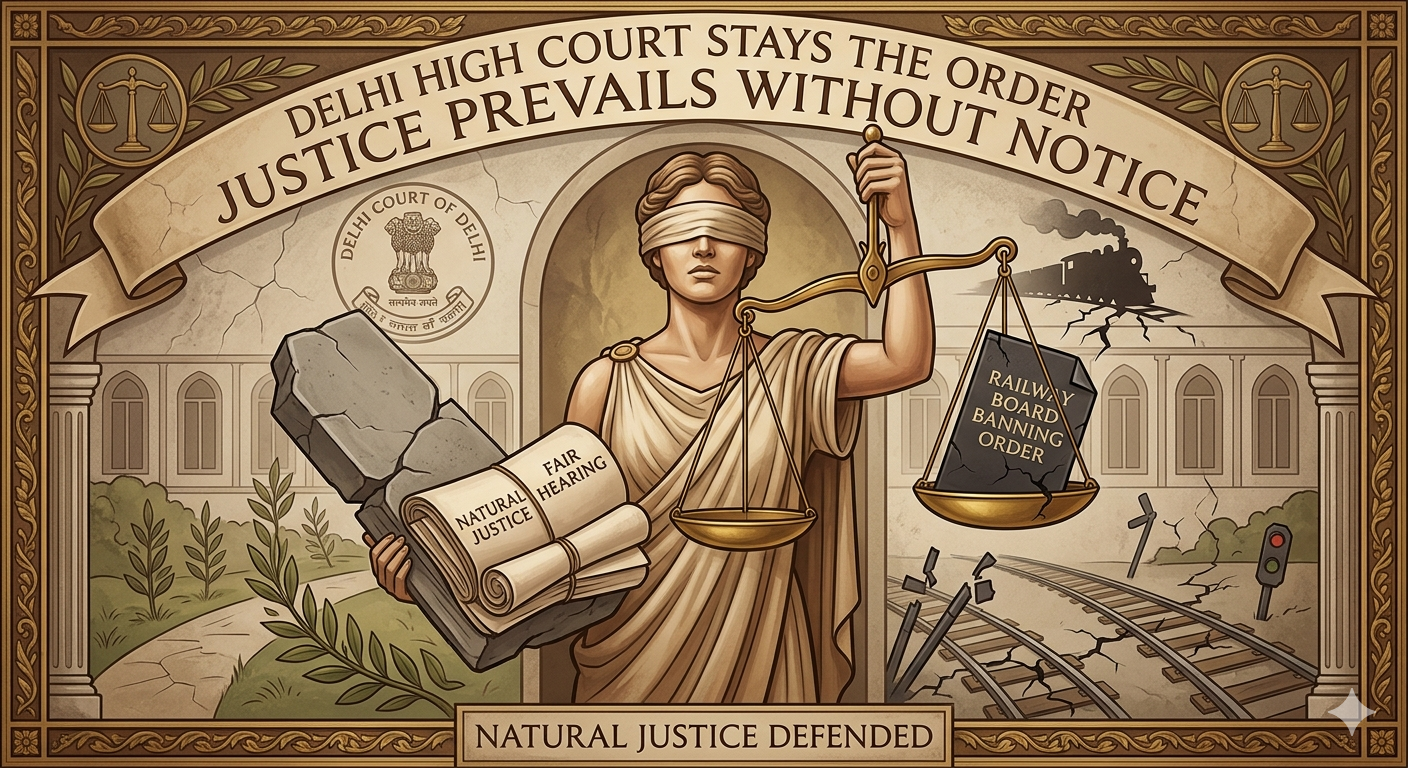
Hon’ble Mr. Justice Sanjeev Sachdeva recorded a clear prima facie finding: the impugned banning order had been passed without issuance of a show cause notice to the petitioner, which was a mandatory precondition both under the general principles of natural justice and under the Railway Board’s own Vigilance Manual. On the basis of this finding, the Court stayed the operation of the banning order against the petitioner until the next date of hearing.
The Railway Board was directed to file a counter affidavit within three weeks, with the petitioner permitted to file a rejoinder within two weeks thereafter. The matter was listed for further consideration in May 2021.
The Lexcuria Team’s Appearance in the Proceedings
The petitioner was represented before the Delhi High Court by Mrs. Maninder Acharya, Senior Advocate, who led the arguments before the Bench. Advocate Madhumita Bhattacharjee, Managing Partner of Lexcuria, appeared as part of the counsel team alongside Mr. Viplav Acharya and Mr. Shikhar Kishore. The matter involved careful engagement with the Railways’ own procedural framework under the Vigilance Manual, the principles of natural justice applicable to quasi-punitive administrative orders, and the distinction between a document addressed to a party and a document that actually issues a show cause notice to that party. The Court’s immediate stay at the interlocutory stage reflected the strength of the prima facie case on the natural justice ground.
Key Legal Principles Affirmed
- A banning order passed by a government department or public authority against a supplier or contractor is a quasi-punitive administrative action that must be preceded by a show cause notice — this is both a requirement of natural justice and, in the Railways’ case, a specific mandate of the Vigilance Manual.
- Being a co-addressee of a show cause notice issued primarily to a different entity does not satisfy the mandatory requirement of giving the affected firm an opportunity to show cause against the specific action proposed against it.
- Where a mandatory precondition to the exercise of a statutory or regulatory power has not been satisfied, a prima facie case for interim relief is made out and courts will grant a stay of the impugned order.
- A firm that has only applied for registration and has not yet been approved as a supplier is not thereby disentitled from the procedural protections of natural justice before a banning order is passed against it.
Conclusion
The Delhi High Court’s interlocutory order of March 15, 2021 is a clear and practical illustration of the principle that procedural fairness is not optional in the exercise of quasi-punitive powers by public authorities. A banning order that deprives a firm of the right to do business with a major public entity for two years is a significant adverse action. The law — both in its general principles and in the Railways’ own internal framework — requires that the affected party be given notice and an opportunity to respond before such an order is made.
The case also highlights a subtle but important point about what constitutes a show cause notice. A document that proposes action against one entity and happens to be copied to another does not constitute a show cause notice to the second entity. For a show cause notice to fulfil its legal purpose, it must be addressed to the right party, identify the specific action proposed against that party, and give that party a genuine opportunity to respond. Anything less is a procedural shell that will not withstand judicial scrutiny.
For firms operating in the public procurement space — as suppliers, contractors, or registered vendors with government departments and public sector undertakings — this case is a reminder that adverse administrative actions, including suspension and banning orders, can be challenged effectively where the prescribed procedural requirements have not been followed. The strength of a natural justice challenge lies not in contesting the substance of the government’s decision, but in holding the authority to the procedural standards it has itself prescribed.
Lexcuria’s appearance in this matter — led by Mrs. Maninder Acharya, Senior Advocate, with Advocate Madhumita Bhattacharjee as part of the counsel team — reflects the firm’s engagement with commercial and public procurement litigation before the Delhi High Court, alongside its established practice in service law, insolvency, and constitutional matters.
Case Reference: W.P.(C) 2075/2021 | High Court of Delhi | Decision Date: March 15, 2021 | Coram: Hon’ble Mr. Justice Sanjeev Sachdeva
Disclaimer: This blog is intended for informational and academic purposes only. It does not constitute legal advice. Readers are advised to consult a qualified legal professional for guidance on specific matters.