Introduction
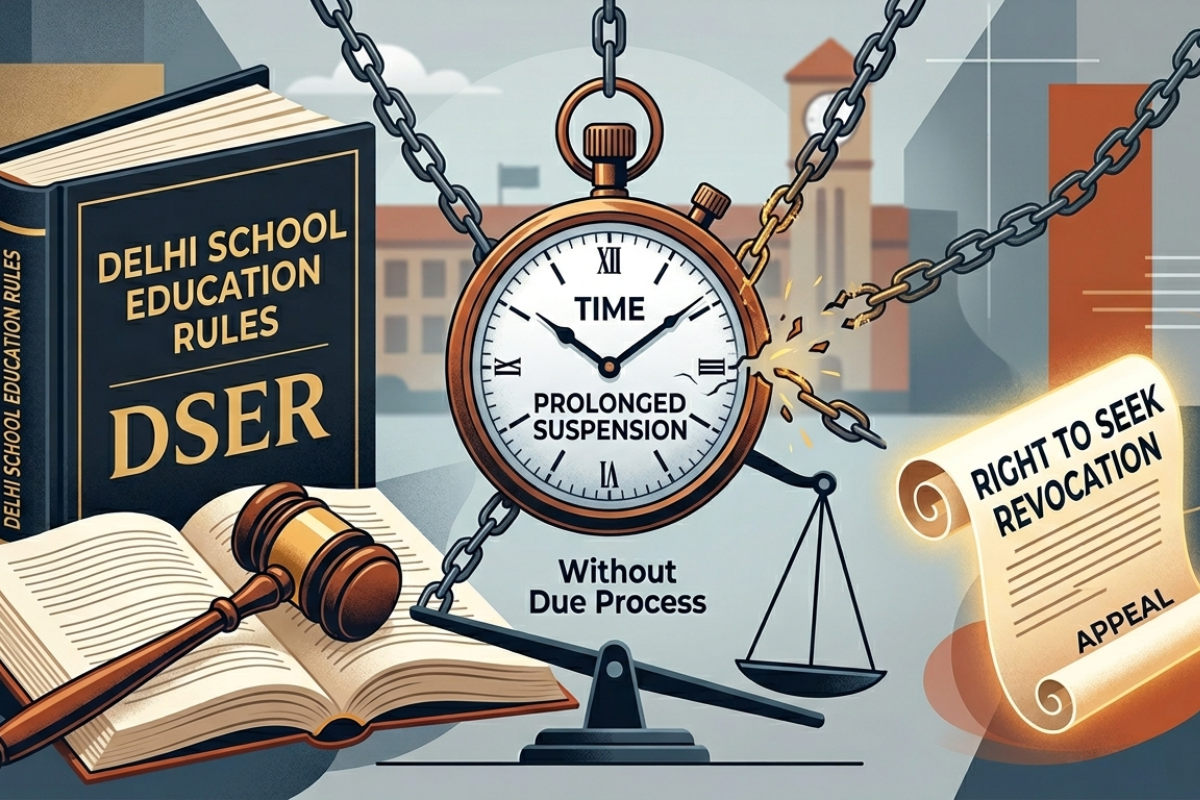
Workplace suspension is one of the most consequential actions an employer can take against an employee. When it is prolonged, unexplained, or procedurally irregular, it ceases to be a neutral administrative measure and begins to resemble punishment — imposed without the safeguards that the law demands before any penalty can be visited upon a person.
A 2017 judgment of the Delhi High Court, in a matter concerning an Assistant Teacher working in the primary wing of a Delhi school, addressed precisely this situation. The case — argued on behalf of the petitioner by Advocate Ms. Madhumita Bhattacharjee, Managing Partner at Lexcuria — raised important questions about the limits of suspension powers, the obligations of disciplinary authorities, and the remedies available to an employee whose representation for revocation of suspension goes unanswered.
Background: The Suspension and the Stalled Inquiry
The petitioner was an Assistant Teacher employed in the primary wing of a private school recognised under the Delhi School Education Act and Rules, 1973. She was placed under suspension in May 2016 following the initiation of disciplinary proceedings against her. A memorandum of charge was issued in August 2016, and an inquiry was conducted pursuant to it.
By the time the matter came before the Delhi High Court, the inquiry had run for well over a year. During this period, the petitioner remained under suspension — unable to perform her duties, her career effectively in limbo. The inquiry had, by the date of hearing, substantially concluded, with the inquiry report placed before the Disciplinary Action Committee of the school for further action.
Crucially, the petitioner had submitted a detailed representation in May 2017 seeking revocation of her suspension, invoking her rights under Rule 115(2) of the Delhi School Education Rules, 1973. Months passed — and no response was given by the school to this representation. It was this unexplained silence that formed the core of the challenge before the Court.
The Legal Framework: Suspension Under Delhi School Education Rules
The Delhi School Education Act and Rules, 1973 constitute the primary legislative framework governing teachers and staff in recognised private schools in Delhi. Rule 115 specifically addresses the powers and procedures relating to suspension of employees.
Rule 115(2) is a protective provision. It recognises that suspension pending inquiry is a temporary measure — not a punitive one — and accordingly provides a mechanism for the suspended employee to seek revocation of the suspension order, particularly where the inquiry has been prolonged or where the continuation of suspension is no longer justified.
Equally significant in this case was Section 8(4) of the Delhi School Education Act, which governs the procedural requirements for suspending a teacher. The first respondent — the Directorate of Education — had itself issued communications in August and October 2017, along with a show cause notice in October 2017, calling upon the school to explain why the petitioner had been suspended without following the proper procedure under Section 8(4). As of the date of hearing, the school had not responded to those communications either.
This double failure — the school’s failure to respond to the petitioner’s representation for revocation, and its failure to respond to the Directorate of Education’s own show cause notice about procedural irregularity — painted a picture of an institution that had placed an employee under suspension and then effectively abandoned the process.
Ms. Madhumita Bhattacharjee’s Role
Appearing for the petitioner, Ms. Madhumita Bhattacharjee placed squarely before the Court the fundamental grievance: that the petitioner had been under suspension for well over a year, her representation seeking revocation had been ignored, and she was being left without any clarity on her employment status or the outcome of the inquiry.
Ms. Bhattacharjee also pointed out a significant factual irregularity raised during the course of the hearing — that the Disciplinary Action Committee, before whom the inquiry report was said to have been placed, did not in fact exist. This observation, recorded in the order, underscored the procedural informality with which the disciplinary process had been conducted against the petitioner.
The Court, taking note of the arguments advanced, issued a structured set of directions designed to bring the matter to a resolution within a defined timeframe.
The Court’s Directions
The High Court, while declining to go into the challenge to the initiation of the inquiry itself (given that the inquiry had substantially concluded), issued the following directions:
The respondent school was directed to respond to the Directorate of Education’s communications dated August 10, 2017 and October 24, 2017, and to the show cause notice dated October 30, 2017, within two weeks.
Upon receipt of the school’s response, the Directorate of Education was directed to decide the petitioner’s representation dated May 11, 2017 — seeking revocation of suspension — within four weeks, and to communicate the outcome to the petitioner.
The Court expressly left open the petitioner’s right to avail of remedies available in law in the event the outcome of the inquiry was adverse to her.
Key Legal Principles: What This Case Illustrates
Several enduring principles of service law and disciplinary proceedings emerge from this judgment.
Suspension Is Not Punishment. It is settled law in India that suspension pending inquiry is a neutral measure intended to facilitate a fair inquiry — not to punish the employee. When it is prolonged without justification or procedural regularity, courts will intervene to ensure that the process is not weaponised.
Representations Cannot Be Ignored. An employee who invokes a statutory rule seeking revocation of suspension has a right to a response. Silence in the face of a formal representation is itself a violation of the principles of natural justice. Courts will direct authorities to decide such representations within defined timelines.
Procedural Compliance Is Non-Negotiable. The existence of statutory requirements under Section 8(4) of the Delhi School Education Act means that schools cannot suspend teachers in a procedural vacuum. Where the regulatory authority itself finds cause to question the procedural legality of a suspension, that is a strong indicator that the suspension may not withstand legal scrutiny.
The Right to Challenge the Outcome Remains Open. The Court’s express preservation of the petitioner’s right to challenge the outcome of the inquiry reflects a broader principle: that disposing of a procedural petition does not foreclose substantive remedies. An employee who participates in an inquiry under protest, or whose representation for revocation is ultimately decided against her, retains all rights to challenge the final penalty before appropriate forums.
Regulatory Oversight of Private Schools. This case also illustrates the important oversight role played by the Directorate of Education in relation to private recognised schools in Delhi. The Directorate’s intervention — issuing communications and a show cause notice to the school about procedural non-compliance — reflects the accountability framework within which such schools operate.
Conclusion
The case is a reminder that the law surrounding employee suspension is not a technicality — it is a carefully calibrated framework designed to balance the employer’s legitimate need to conduct an inquiry with the employee’s right to procedural fairness and timely resolution.
For teachers and staff in recognised schools in Delhi, Rule 115(2) of the Delhi School Education Rules provides an important statutory tool. For school managements, this judgment underscores that procedural shortcuts in disciplinary matters carry legal risk — and that regulatory authorities will not hesitate to step in where due process has been bypassed.