Introduction: A Decade-Long Fight for a Rightful Appointment
Service law disputes in the education sector often turn on fine distinctions — between teaching and non-teaching staff, between mandatory timelines and discretionary powers, and between circulars that apply prospectively and those that cannot be read backwards in time. A ruling by the Hon’ble High Court of Delhi dated December 4, 2017, in W.P.(C) 2272/2012, navigated all three of these questions in a case that had its roots in a recommendation made nearly a decade earlier.
The case was argued on behalf of the petitioner by the team of Ms. Madhumita Bhattacharjee, Advocate, and raised important questions about age relaxation for Librarians in Delhi schools, the applicability of the ‘deemed approval’ rule under the Delhi School Education Rules, 1973, and the retrospective effect of government circulars. While the petition was ultimately dismissed, the ruling offers a detailed and authoritative analysis of the legal framework governing school staff appointments in Delhi.
Background: A Recommended Appointment That Never Materialised
The petitioner had been recommended by the Selection Committee of a private recognised school for appointment to the post of Librarian. The recommendation, however, came with a condition: it was subject to the grant of age relaxation by the Directorate of Education (DoE), since the petitioner exceeded the applicable age limit for the post.
The School’s Selection Committee had included a nominee of the Directorate of Education — a standard requirement under the Delhi School Education Rules — which meant the DoE was not a stranger to the recommendation being made.
The petitioner’s case rested on a Circular dated 3rd May, 1976, which provided for age relaxation in recruitment to various categories of Teachers. The petitioner’s argument was that since Librarians are equated with Teachers, the benefit of this age relaxation circular ought to extend to Librarians as well.
The Directorate of Education, however, refused to grant the approval, specifically observing that the 1976 Circular applied to Teachers, while the petitioner was being appointed as a Librarian — a Non-Teaching Staff position. The DoE’s refusal was communicated in October 2008. A Representation filed by the petitioner in November 2008 was decided against him in February 2011, leading to the second round of litigation before the High Court.
The Legal Arguments: Three Distinct Grounds Pressed Before the Court
Ground 1 — Librarians Are Equated With Teachers
The petitioner’s counsel drew the Court’s attention to a Circular dated 20th January, 2009, which placed Librarians alongside Teachers in the context of pay scales. The argument was that this equating of Librarians with Teachers — even in the context of pay — was sufficient to entitle a Librarian to claim the same age relaxation as Teachers under the 1976 Circular.
Reliance was also placed on a decision of a coordinate bench of the Delhi High Court in Smt. Promila Dixit v. Govt. of NCT of Delhi, which had engaged with the question of whether a Librarian could be treated at par with a Teacher in matters of service.
Ground 2 — Deemed Approval Under Rule 98
One of the most technically interesting arguments in the case related to the concept of ‘deemed approval.’ The petitioner’s counsel pointed to Sub-Rule 4 of Rule 98 of the Delhi School Education Rules, 1973, which provides that if the Directorate of Education does not convey its approval or disapproval of a Selection Committee’s recommendation within 15 days, there shall be a deemed approval.
The argument was compelling in its structure: the Selection Committee had included a DoE nominee, the recommendation had been made, and the disapproval was not conveyed to the school within the mandatory 15-day window. By operation of law, therefore, the recommendation should be treated as having received deemed approval — making the petitioner’s appointment valid and enforceable.
Ground 3 — The Retrospectivity Argument
A third dimension of the case arose from an Office Order dated 21st January, 2011, issued by the Directorate of Education, which for the first time directed that Librarians would also take classes in addition to their library duties. This, the petitioner argued, effectively equated Librarians with Teachers in function — and should be read together with the 1976 age relaxation circular to justify his appointment.
What the Delhi High Court Held
On the Librarian-Teacher Equation
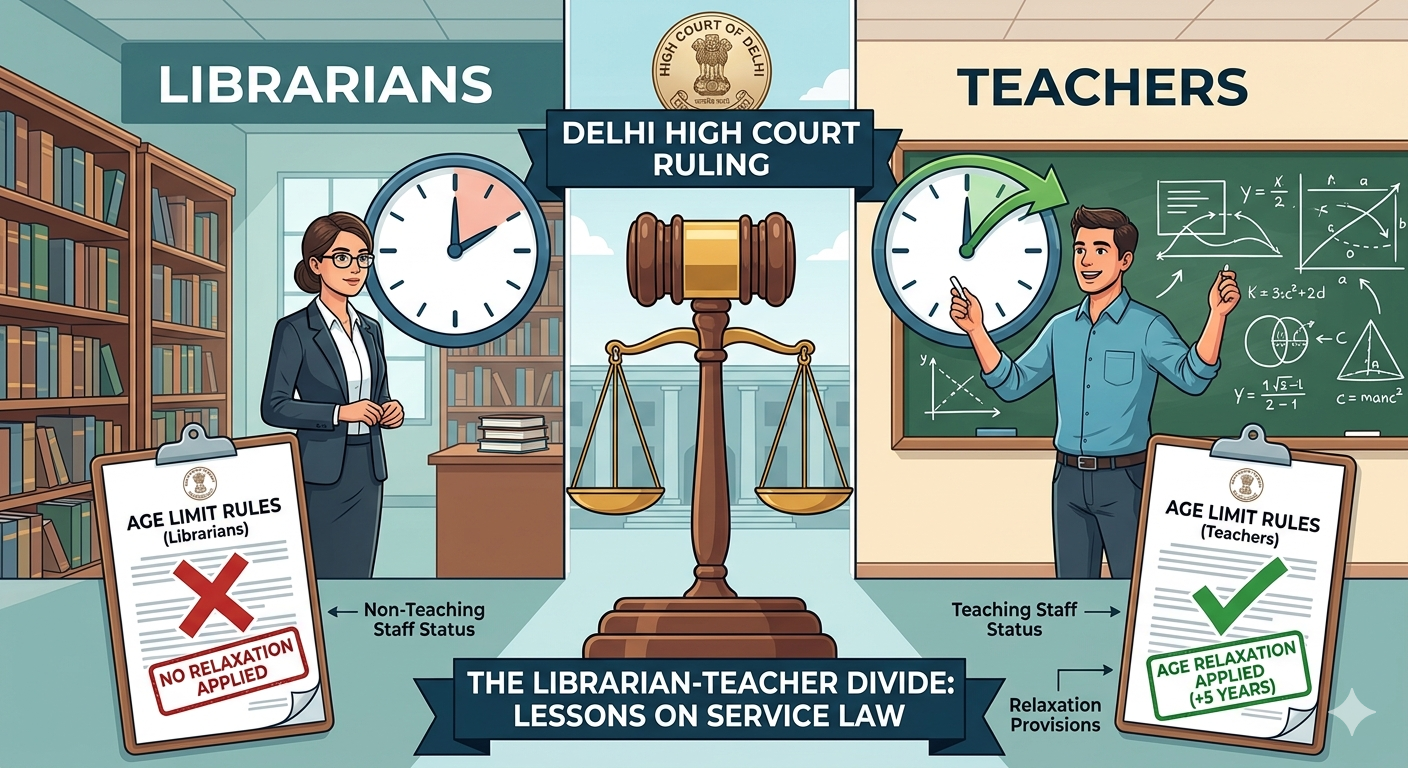
The Court held that the 1976 Circular was specifically addressed to recruitment of Teachers and could not be extended to cover Librarians, who were classified as Non-Teaching Staff at the relevant time. The January 2009 Circular on pay scales, the Court found, did not alter this position — it addressed pay scales only, not service conditions such as age relaxation.
The coordinate bench decision in the Promila Dixit case was distinguished on its facts. In that case, a teacher had already served the school for a year and a half, and the Court allowed her to continue — but specifically stated the decision carried no precedential value. Moreover, that case involved continuation of service, not a fresh appointment.
On the Deemed Approval Argument
This was the argument on which the Court spent the most analytical attention — and where the distinction between Rule 97 and Rule 98 became decisive.
The Court held that the petitioner’s case was not a routine selection by a Selection Committee or DPC, which would fall under Rule 98. Rather, it was a recommendation that was explicitly subject to the grant of age relaxation — a condition that required the specific approval of the Directorate of Education under Rule 97.
Rule 97, unlike Rule 98, prescribes no time limit for the DoE to act. There is therefore no provision for deemed approval under Rule 97. Since the petitioner’s case required age relaxation — which is governed by Rule 97 — the 15-day deemed approval provision of Rule 98 was simply inapplicable.
This was a significant ruling on a technical but important point of service law: the deemed approval mechanism does not operate universally across all types of school appointments. Where the appointment requires an additional discretionary element — such as age relaxation — the specific rule governing that element applies, and the time-bound deemed approval mechanism of Rule 98 does not override it.
On Retrospective Application of the 2011 Office Order
The Court held that the Office Order of January 21, 2011 — which first required Librarians to take classes and thereby equated them functionally with Teachers — could not be applied retrospectively to a recommendation made in 2008. Administrative orders operate prospectively unless they explicitly state otherwise. Since the petitioner’s recommendation pre-dated the 2011 order by three years, he could not derive any benefit from it.
The petition was accordingly dismissed, with parties directed to bear their own costs.
Key Legal Principles Emerging From This Case
The Librarian-Teacher Distinction Has Service-Specific Consequences
Librarians in Delhi schools occupy an intermediate position — equated with teachers in some respects (such as pay scales) but classified as Non-Teaching Staff for others (such as age relaxation under pre-2011 circulars). This distinction has real consequences for appointment conditions and must be carefully navigated.
Deemed Approval Under Rule 98 Has a Limited Scope
The 15-day deemed approval provision of Rule 98 of the Delhi School Education Rules applies to routine selections — not to cases requiring additional discretionary approvals such as age relaxation. Candidates and schools must be aware that invoking deemed approval in the context of conditional recommendations will not succeed if the applicable rule is Rule 97.
Government Circulars and Office Orders Are Prospective Unless Expressly Stated Otherwise
A circular or office order that changes the classification or duties of a category of employees does not retrospectively alter the service conditions of individuals whose cases were already under consideration before the circular was issued.
Second Rounds of Litigation Must Be Built on New Legal Ground
This was the second round of litigation in this matter. Courts in service matters will carefully examine whether the subsequent challenge raises legally distinct grounds — and will not re-open what has already been decided.
Conclusion: Precision in Service Law Requires Knowing Which Rule Applies
The outcome of this case turns on a single, precise question: was this appointment governed by Rule 97 or Rule 98 of the Delhi School Education Rules? That distinction — invisible at first glance — determined whether the 15-day deemed approval mechanism was available at all.
The case illustrates how service law disputes in the education sector can involve layered technical arguments, multiple circulars from different years, and distinctions between prospective and retrospective operation of government orders. Navigating this terrain requires not just familiarity with the rules, but a thorough understanding of how they interact with each other and with the specific facts of each case.