Introduction: A Procedural Battle With Substantive Consequences
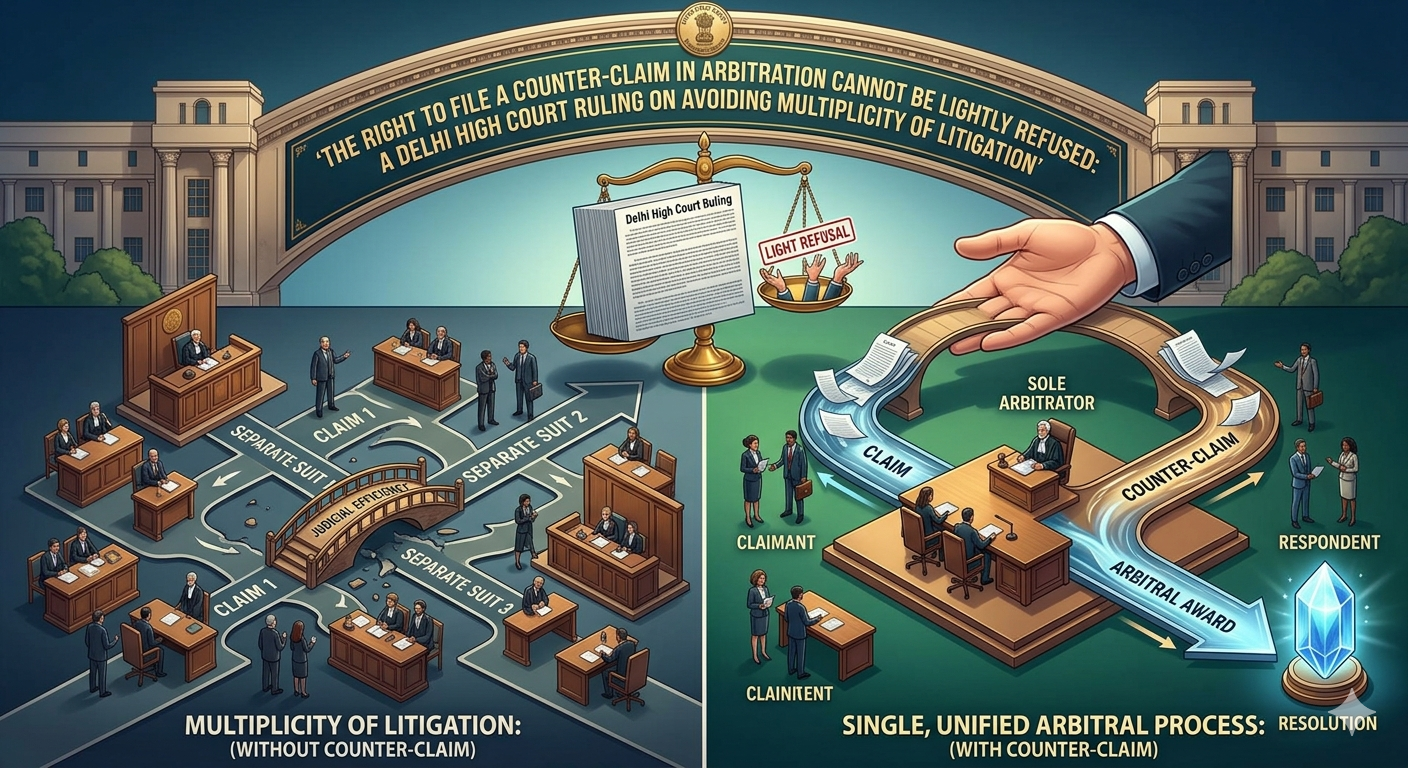
In arbitration proceedings, procedural orders often carry consequences as significant as the final award itself. One such critical procedural moment is the filing of a counter-claim — a respondent’s opportunity to raise its own grievances within the same forum rather than initiating an entirely separate legal proceeding. When an Arbitrator refuses permission to file a counter-claim, it does not merely delay justice; it can force a party into a second round of litigation that could have been avoided entirely.
A significant ruling by the Hon’ble High Court of Delhi dated October 1, 2018, in O.M.P. (COMM) 343/2018, addressed exactly this situation. The case, argued by Ms. Madhumita Bhattacharjee, Advocate, resulted in the setting aside of an Interim Arbitral Order that had refused permission to file a counter-claim — with the Delhi High Court affirming that the object of arbitration law is to achieve complete and just adjudication of all disputes between parties in a single forum.
Background: How the Dispute Reached This Point
The dispute arose from a commercial contract between two private entities. An Arbitrator had been appointed by the Delhi High Court on an application filed by the claimant under Section 11 of the Arbitration and Conciliation Act, 1996.
Once the arbitration commenced, a procedural timeline was set:
- The claimant was directed to file its Statement of Claim by September 15, 2017.
- The respondent (petitioner in the present proceedings) was directed to file its reply and counter-claim, if any, by September 25, 2017.
The timeline, however, unravelled almost immediately. The claimant sought and was granted further time to file its Statement of Claim. The petitioner received the claimant’s Statement of Claim only in November 2017 — nearly two months after the original deadline.
Faced with this delay, the petitioner took a significant legal step: it challenged the jurisdiction of the Arbitrator by filing an application under Section 16 of the Arbitration Act. This jurisdictional challenge was dismissed by the Arbitrator in January 2018. The petitioner then filed its Statement of Defence in February 2018. In May 2018 — approximately three months later — it filed an application seeking permission to file its counter-claim.
The Arbitrator dismissed this application, holding that the reasons offered (inadvertence, combined with the pending jurisdictional challenge) were contradictory, and that allowing the counter-claim at such a stage would delay the proceedings. This dismissal was challenged before the Delhi High Court under Section 34 of the Arbitration Act.
Ms. Madhumita Bhattacharjee’s Arguments Before the Court
On the Jurisdictional Challenge as Justification for the Delay
Her most significant submission addressed the apparent contradiction identified by the Arbitrator. She explained that while the petitioner’s Section 16 application challenging jurisdiction was pending, the petitioner was in a legally uncertain position regarding whether filing a counter-claim would be appropriate or even maintainable. A party that believes an Arbitrator lacks jurisdiction is understandably reluctant to simultaneously participate in the substantive proceedings by filing a counter-claim — to do so could be read as an implied acceptance of that very jurisdiction being challenged.
It was only after the jurisdictional challenge was dismissed in January 2018, and upon receiving legal advice thereafter, that the petitioner decided to press its counter-claim and filed the application promptly.
On the Stage of Proceedings
Ms. Bhattacharjee submitted that at the time the application to file the counter-claim was made, the arbitration proceedings were still at an early evidential stage. While affidavits of evidence had been filed, no witness of either side had yet been cross-examined. This was a critical factual point — it meant that allowing the counter-claim would not require any already-completed evidence to be revisited or re-examined.
On Prejudice and Multiplicity
She forcefully argued that no real prejudice would be caused to the claimant if the counter-claim were admitted. On the contrary, refusing it would force the petitioner to initiate an entirely separate arbitration or legal proceeding on the same set of facts — resulting in the very multiplicity of litigation that arbitration law is designed to prevent.
What the Delhi High Court Held
1. The Delay Was Not Substantial
The Court noted that the gap between the filing of the Statement of Defence (February 2018) and the counter-claim application (May 2018) was approximately three months — and that in this intervening period, no further substantial arbitral proceedings had taken place. A three-month delay in these circumstances was not, in the Court’s view, of a nature that warranted a complete refusal to admit the counter-claim.
2. The Jurisdictional Challenge Explained the Timing
The Court accepted the logic of Ms. Bhattacharjee’s submission: a party that is actively challenging an Arbitrator’s jurisdiction is placed in a difficult position when it comes to filing a counter-claim. The apparent contradiction identified by the Arbitrator was not a genuine contradiction but rather a reflection of the legal complexity the petitioner had navigated.
3. The Object of Arbitration Law: Avoiding Multiplicity
The Court drew on two significant Supreme Court judgments to reinforce its conclusion:
In State of Goa v. Praveen Enterprises, (2012) 12 SCC 581, the Supreme Court held that the object of counter-claims in arbitration is to avoid multiplicity of proceedings and ensure complete adjudication of all disputes between the parties.
In Vijay Prakash Jarath v. Tej Prakash Jarath, (2016) 11 SCC 800, the Supreme Court set aside a High Court order refusing a counter-claim on the ground of delay — even in a case involving a delay of two and a half years — holding that no prejudice had been caused to the other party. If a delay of two and a half years was not sufficient to bar a counter-claim in that case, a three-month delay was clearly insufficient to justify a refusal in the present one.
4. Arbitrator Should Have Imposed Costs, Not Refused the Application
The Court held that the Arbitrator’s approach was legally flawed. The correct course of action would have been to allow the counter-claim subject to costs — thereby compensating the claimant for any delay while still ensuring that all disputes between the parties were resolved in the same forum. An outright refusal was a disproportionate response.
5. The Impugned Order Was Set Aside
The Interim Arbitral Order refusing permission to file the counter-claim was set aside in its entirety. The counter-claim was directed to be taken on record and adjudicated in the ongoing arbitral proceedings. The petitioner was, however, directed to pay costs of ₹50,000/- to the claimant, reflecting the delay caused.
Key Legal Takeaways
Counter-Claims in Arbitration Are Strongly Favoured by Law
The entire architecture of arbitration law — including the ability to raise counter-claims — is built on the principle of efficient, consolidated dispute resolution. Courts and arbitrators should lean towards admitting counter-claims rather than refusing them, unless there is clear and demonstrable prejudice to the other party.
Pending Jurisdictional Challenges Have a Natural Bearing on Counter-Claim Timing
A party that is challenging an arbitrator’s jurisdiction under Section 16 is in a legally complex position. Courts should interpret any resulting delay in filing counter-claims with appropriate sensitivity to this procedural reality, rather than treating it as mere inadvertence or bad faith.
Costs Are the Appropriate Remedy for Delay — Not Exclusion
The Delhi High Court’s direction in this case is important: where a counter-claim is filed late, the correct judicial response is to impose costs on the defaulting party — not to shut it out from the proceedings entirely. Exclusion should be a last resort, reserved for cases of gross delay or demonstrated prejudice.
Section 34 Petitions Lie Against Interim Arbitral Orders
This case also affirms that an Interim Award or procedural order by an Arbitrator — such as one refusing permission to file a counter-claim — is challengeable before the High Court under Section 34 of the Arbitration and Conciliation Act. Parties should be aware of this avenue when faced with adverse procedural rulings in arbitration.
Conclusion: Procedural Fairness Is at the Heart of Arbitral Justice
The outcome in this case reflects a principled insistence on procedural fairness in arbitration. By successfully challenging the Arbitrator’s refusal, Ms. Madhumita Bhattacharjee ensured that her client retained the right to have its own claims adjudicated — not in a future, separate proceeding, but alongside the very dispute that had already been submitted to arbitration.
For businesses and individuals involved in commercial arbitration, this case serves as an important reminder: procedural orders in arbitration are not immune from judicial review, and the courts will intervene where an arbitral tribunal has exercised its procedural discretion in a manner inconsistent with the fundamental objectives of arbitration law.