In urban development and municipal law, the relationship between property developers, educational institutions, and municipal corporations is frequently shaped by notifications that impose or revise charges for enhanced Floor Area Ratio (FAR). When a property owner complies with a notification and deposits substantial additional charges to secure the benefit of increased FAR, only to find that a subsequent notification issued by the same authority liberalises or removes the requirement to make those payments, a fundamental question of fairness and law arises: is the property owner entitled to a refund?
A Division Bench of the Delhi High Court delivered a landmark answer to this question on September 4, 2017, dismissing two Letters Patent Appeals filed by the South Delhi Municipal Corporation and affirming the Single Judge’s directions for refund of substantial additional FAR charges paid by two respondent institutions. Advocate Madhumita Bhattacharjee, Managing Partner of Lexcuria, appeared as counsel for one of the respondents — an educational society — in the first of these two connected appeals.
Background: Two Notifications, Substantial Payments, and a Demand for Refund
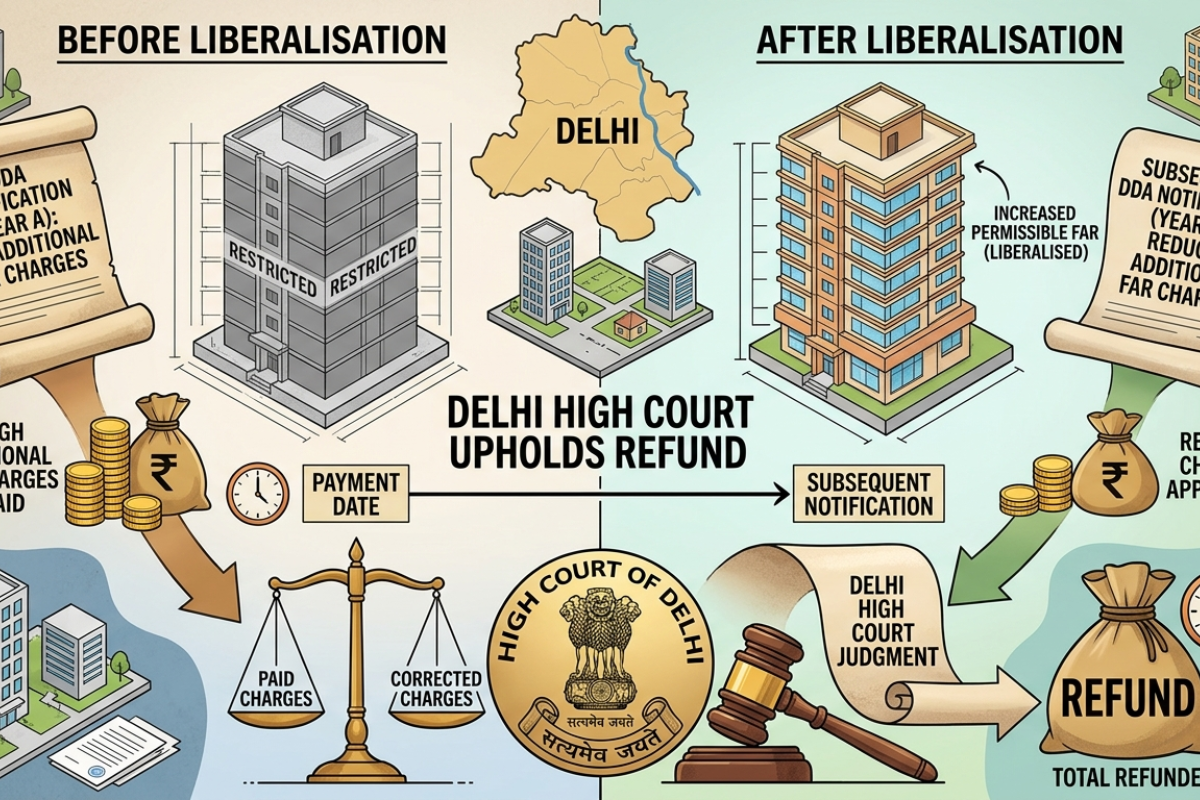
The facts underlying both appeals follow a similar pattern. The Delhi Development Authority’s regulations governing Floor Area Ratio — the ratio of a building’s total floor area to the size of the land on which it is built — were modified. A notification dated December 23, 2008 required property owners seeking the benefit of increased FAR to deposit additional charges as a condition of securing that benefit. Both institutions complied with this requirement and made the stipulated payments.
Subsequently, a revised notification dated July 17, 2012 modified the position: it absolved those who had obtained the benefit of increased FAR from the obligation to deposit or pay the additional amounts. The legal question this raised was significant: did the benefit of the 2012 notification extend to those who had already paid under the 2008 notification? If so, were those amounts refundable?
The institutions approached the Delhi High Court seeking refund of the additional charges they had paid under the 2008 notification. The Single Judge allowed both writ petitions, directing refund of Rs. 3,65,54,800 with interest at 12% per annum in the first case, and Rs. 2,10,27,645 from the date of judgment in the second case. The Municipal Corporation appealed both orders before a Division Bench.
Advocate Madhumita Bhattacharjee’s Role in the Proceedings
Advocate Madhumita Bhattacharjee appeared as counsel for the educational society respondent in the first of the two connected appeals — LPA 690/2016 — before the Division Bench of the Delhi High Court. She defended the Single Judge’s order directing refund of over Rs. 3.65 crore with interest, advancing the respondent’s position that the 2012 notification’s liberalisation of the FAR charge requirement conferred a benefit that ought to extend to those who had already paid under the earlier notification, and that the writ petition had been filed within a reasonable time after the right to seek refund had crystallised.
The Division Bench’s Reasoning: Appeals Dismissed on All Grounds
The Division Bench dismissed both appeals, finding them “facially untenable.” The Court’s reasoning addressed two principal contentions raised by the Municipal Corporation.
The Limitation and Laches Argument Was Rejected. The Corporation argued that monetary claims should not be entertained under Article 226 of the Constitution, and that the petitions were filed beyond the period of limitation. The Division Bench firmly rejected this contention. Citing the Supreme Court’s observations in Dwarka Nath v. Income-Tax Officer [AIR 1966 SC 81], the Court reiterated that the use of the expression “appropriate proceedings” in the constitutional framework was intended to liberate Indian courts from the constraints of traditional civil jurisprudence. Procedure is the handmaiden of justice — not its master.
The Court further held that the right to seek a refund could only have accrued after the Division Bench’s ruling in the DDA v. Jagan Nath Memorial Educational Society case in April 2014, which had established that the benefit of the 2012 notification extended to those who had paid under the earlier notification. It was only from April 30, 2014 that the legal basis for seeking a refund was clearly established. Filing the writ petition thereafter was within reasonable time — and the laches bar did not apply.
Beneficial Notifications Must Be Construed Liberally. The Court affirmed the Single Judge’s reliance on the principle that beneficial notifications, even if not explicitly made retrospective in terms, ought to be construed in a manner that confers the intended benefit upon those who had already complied with the earlier requirement. The 2012 notification was a liberalising measure — its purpose was to remove the additional charge obligation. To confine its benefit only to those who had not yet paid, while leaving those who had diligently complied with the earlier notification to bear the burden, would be both arbitrary and contrary to the spirit of the liberalisation.
Interest on Delayed Refund: The Default Rate Clarified. While upholding the refund directions, the Division Bench clarified an ambiguity in the Single Judge’s order regarding the applicable interest rate. The Court confirmed that the institution in the first appeal was entitled to Rs. 3,65,54,800 together with interest at 12% per annum, and that in the event of non-payment of the principal and interest accrued until September 26, 2016, the interest at 12% per annum would continue to run. This ensured that the Corporation could not delay payment without the interest burden escalating accordingly.
Key Legal Principles Affirmed
- When a municipal or regulatory authority issues a liberalising notification that removes or reduces a financial obligation, those who have already complied with the earlier obligation are entitled to the benefit of the liberalisation — and to a refund of amounts paid under the earlier regime.
- Beneficial notifications should be construed in a manner consistent with their liberalising purpose, even where they are not explicitly made retrospective in terms.
- The limitation bar in writ proceedings under Article 226 is discretionary, not jurisdictional. Where a party approaches the court within a reasonable time after the right to seek the remedy has crystallised, laches will not bar the claim.
- Monetary claims against public authorities are entertainable under Article 226, particularly where the claim arises from an unconstitutional or unlawful exaction and the right to refund has been established by judicial authority.
Conclusion
The Delhi High Court’s Division Bench judgment of September 4, 2017 is a landmark in Delhi municipal property and development law. It establishes, with the authority of a Division Bench, that where a party has paid additional FAR charges under a notification that is subsequently superseded by a liberalising notification, the earlier payer is not to be left worse off than those who paid nothing. The benefit of the liberalisation must flow to them, and the authority that collected the charges must refund them with interest.
The judgment is also significant for its clear statement on the limitation question in writ proceedings involving monetary claims against public authorities. The right to approach the court does not arise until the legal basis for the claim is established — and once it is, the court will not shut out a claimant on technical grounds of delay where the approach is reasonable.
For educational institutions, commercial developers, and other property owners in Delhi who have paid additional charges under municipal or DDA notifications that have subsequently been revised or liberalised, this judgment provides a clear and powerful precedent. The amounts paid are refundable, the right to seek refund survives, and the courts have the jurisdiction and the willingness to enforce it.
Advocate Madhumita Bhattacharjee’s successful defence of the Single Judge’s order before the Division Bench in this matter — securing the affirmation of a refund exceeding Rs. 3.65 crore with 12% interest — reflects Lexcuria’s engagement with municipal and development law litigation at the Delhi High Court, alongside the firm’s established practice in service law, insolvency, and constitutional matters.