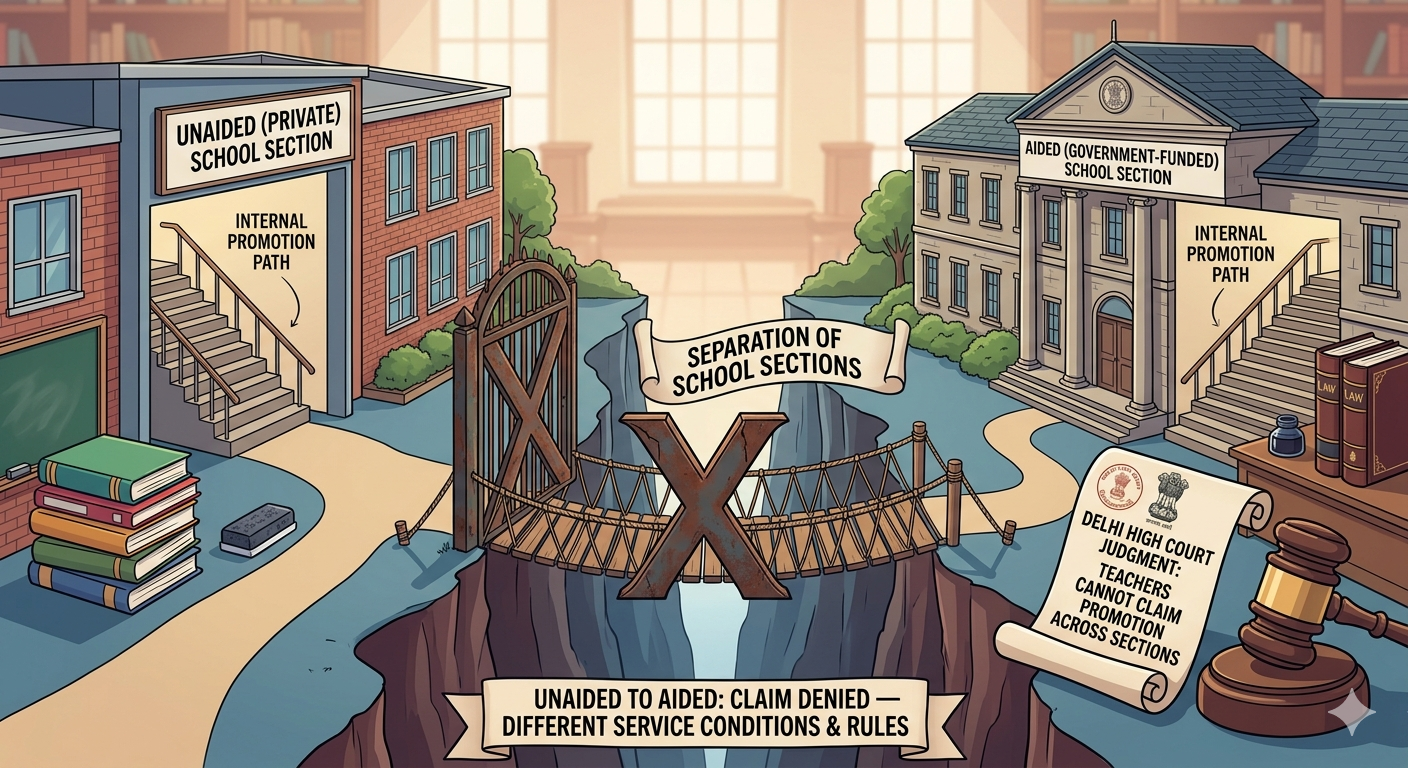
Can a teacher employed in the unaided primary section of a school claim a right of promotion to the aided secondary section of the same school — simply because both sections are run under the same Society? This was the pivotal question before the Delhi High Court in a case that drew the legal boundary between unaided and aided educational institutions, with significant implications for teachers, school managements, and education authorities across Delhi.
The answer, as the Delhi High Court held, is a firm no. And the reasoning behind this conclusion offers important lessons in the law governing private schools, the rights of employees, and the limits of institutional identity under the Delhi School Education Act, 1973.
The Background: A Decade-Long Employment Dispute
The petitioners were a group of teachers employed as Assistant Teachers in the primary section of a private school in Delhi — a section that had received recognition in December 1993. The school also had a separate secondary section, running from Classes 6 to 12, which was a recognized aided school receiving State funding.
The petitioners claimed that they were qualified for promotion to the post of Trained Graduate Teacher (TGT) in the secondary section, and that with seven vacancies available, they ought to be considered for promotion rather than having those posts filled through direct recruitment. They argued that since both sections of the school were run by the same Society, they were entitled to be treated as part of a common institutional framework for employment purposes.
The school management and the Directorate of Education both opposed the claim. The Directorate took the position that employees of the unaided primary section could not be transferred, absorbed, or promoted into the aided secondary section, as these were governed by entirely different rules and funding structures.
The Legal Framework: What Separates Aided from Unaided?
To understand the Court’s reasoning, it is important to appreciate the fundamental distinction between aided and unaided private schools under the Delhi School Education Act, 1973.
In an aided school:
- The State or the Municipal Corporation bears 95% of the salary burden of all employees.
- The grant-giving authority — the State or MCD — prescribes detailed recruitment and promotion rules.
- The Directorate of Education retains significant regulatory oversight over staffing decisions.
In an unaided private recognized school:
- The management bears the entire salary burden of its employees.
- The school is entitled to maximum autonomy in staffing and administration, as held by a Division Bench of the Delhi High Court.
- The relationship between management and employees is essentially contractual.
This structural distinction was the foundation of the Court’s analysis. Since different rules govern the two types of institutions, and since the State bears substantial financial liability only for aided school employees, it follows that the State has a legitimate interest in regulating who benefits from that funding — and promotion from an outside entity into an aided position would bypass that regulatory control entirely.
The Court’s Analysis: Separate Institutions, Separate Rules
The Court rejected each of the petitioners’ arguments methodically:
1. The ‘Same Society’ Argument
The petitioners relied heavily on the fact that both sections were run by the same Society. The Court held that this was legally irrelevant. Under the Delhi School Education Act, each school is managed by a Managing Committee — a distinct entity from the Society or Trust that established it. Even if the membership of two Managing Committees overlapped entirely, they would still constitute separate legal entities. The common umbrella of a shared Society cannot merge what are legally distinct institutions.
2. Promotion Rights Exist Within an Institution, Not Across Institutions
The Court reiterated the settled legal principle that the right to promotion can only be claimed within the same institution, service, or cadre — not in a different institution. The unaided primary school and the aided secondary school, despite sharing a common Society, are separate schools in law. A school under the Delhi School Education Rules is not required to comprise all classes; it can be a standalone primary, secondary, or senior secondary school.
3. The Backdoor Entry Problem
The Court observed that allowing employees of an unaided school preferential access to aided positions would violate the principle of open competition and amount to backdoor entry into public-funded employment — a practice that the Supreme Court of India has firmly decried. Indeed, the applicable rules go further in the opposite direction: an aided school is required to give first preference to surplus employees of other aided schools, not to employees of unaided institutions.
4. Reliance on Earlier Notifications
The petitioners placed reliance on two administrative notifications — one from 1979 on common seniority lists and another from 1987 on promotion from primary to secondary sections. The Court distinguished both: the 1979 notification dealt with common seniority across different aided schools of the same Society; the 1987 notification applied only to schools recognised by the MCD, not the Directorate of Education. Neither addressed the specific situation of an unaided primary school and an aided secondary school. Moreover, any such notifications could not survive the subsequent judicial recognition of full autonomy for private unaided schools.
Advocate Madhumita Bhattacharjee: Representing the Teachers’ Cause
Advocate Madhumita Bhattacharjee appeared in this matter on behalf of the petitioner-teachers — a group of primary school educators who had spent years in service expecting a path to career advancement through the secondary section of the same institution.
The case presented a genuinely difficult situation. The teachers were not wrong to believe that institutional continuity under a common Society ought to carry some weight in their careers. Advocate Bhattacharjee advanced the argument that the common umbrella of the same Society, coupled with the administrative notifications permitting cross-school promotion, ought to entitle them to consideration for the vacant TGT posts. The submission highlighted the real-world impact on educators who had served loyally in the primary section with reasonable expectations of professional growth.
While the Court ultimately ruled against the petitioners on the legal question, the case itself — and the continued engagement of counsel over subsequent years — remained alive. The matter appears to have been referenced in later proceedings, including in the context of salary entitlements of the same teachers before another Bench of the Delhi High Court in 2015. This continuity reflects the broader reality that education law disputes rarely resolve with a single judgment; they evolve as the underlying employment relationships continue.
Key Takeaways from This Judgment
- Aided and unaided sections of the same school are legally separate institutions — sharing a common Society does not merge them.
- The right to promotion exists within the same institution, service, or cadre — not across different institutions, even if established by the same Trust.
- Employees of unaided schools cannot claim preferential access to aided positions — this would amount to backdoor entry into State-funded employment.
- Private unaided schools enjoy maximum autonomy in staffing matters — and this autonomy cuts both ways, insulating them from external claims as well.
- When vacancies arise in aided schools, the rules require first preference to surplus employees from other aided schools — not employees from unaided institutions.
- Administrative notifications issued before the landmark judgment on school autonomy must be read in light of the evolved legal framework.
Why This Matters Beyond the Classroom
This judgment is more than a ruling on the promotion rights of seven teachers. It clarifies the legal architecture of private school management in Delhi — an architecture in which the identity of a school is defined not by who controls it at the top but by the regulatory and financial framework within which it operates.
For school societies that run both aided and unaided institutions, the ruling signals that they cannot use the overlap of institutional identity to transfer benefits — or liabilities — from one category to the other. Employment in an unaided school is an employment in that school, governed by the contractual arrangement with its management. It confers no automatic rights over the aided section’s positions, which are subject to an entirely different regulatory regime.
For teachers working in unaided sections, the ruling underscores the importance of clearly understanding the nature of their employment at the outset — the terms, the scope for advancement, and the institutional structure within which they work. In an era where right to education and service law intersect in increasingly complex ways, such clarity is invaluable.
For parents and students, the case is also a reminder of the real-world cost of prolonged litigation: the interim stay on filling TGT vacancies meant that students of the secondary section went without fully staffed classrooms for over a year — a consequence that the Court itself acknowledged with concern.